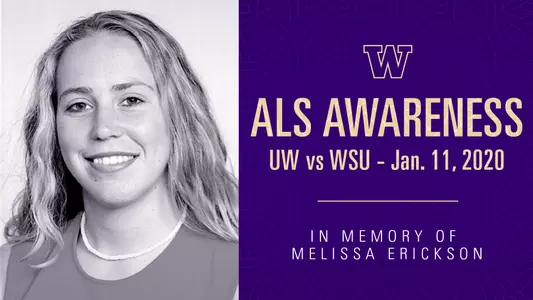
UW Hosts ALS Awareness Game Saturday to Honor Former Husky Melissa Erickson
January 10, 2020 | Women's Basketball
The University of Washington women's basketball team's annual alumni day is Saturday; a day which will be filled with former Huskies returning to the place they spent a small part of their lives playing the game they love.
One former Husky who will not be back on the Hec Ed court will be Melissa Erickson—a former Washington player from 1997-2001, who lost her battle against ALS in 2013 at the age of 34. To honor her memory, the current and former Huskies are hosting ALS Awareness day Saturday to celebrate the life of Melissa and raise awareness for programs both on and off campus.
Erickson wore the purple and gold in 92 games over her four years at UW, scoring 227 points and earning a reputation as a tough and gritty player on the court. She suffered an ACL injury as a senior but provided support from the bench for the Husky team which reached the NCAA Elite Eight in 2001.
After graduating from Washington with a degree in sociology, Erickson became an assistant coach at Centenary College in Shreveport, Louisiana, then went on to be a basketball operations assistant at UNLV. One year later, she headed to Europe and played professionally in Germany and Portugal.
It was in Portugal she began noticing muscle weakness and a lack of energy during her games. Upon returning to the United States, she experienced muscle spasms and had difficulty lifting during weight training sessions. After a battery of tests with different specialists, she was diagnosed with ALS (Amyotrophic Lateral Sclerosis)—also known as Lou Gehrig's Disease—on the eve of her 28th birthday.
The ALS Association has a simple definition of ALS: it is a progressive neurodegenerative disease which affects nerve cells in the brain and spinal cord. ALS kills motor neurons which your body uses to make muscles contract. Over time, those muscles weaken, and the disease gradually prohibits the ability for those afflicted with the disease to walk, grasp objects, speak, swallow, move and breathe.
ALS usually strikes people between the ages of 40 and 70 but can affect anyone at any time—as Erickson learned at the young age of 27. It is estimated that more than 16,500 Americans are living with ALS. Just a few of the notable individuals who have been diagnosed with ALS include baseball great Lou Gehrig, theoretical physicist, cosmologist and author Stephen Hawking and Hall of Fame pitcher Jim "Catfish" Hunter.
But right now, the most troubling fact about ALS is that there is no cure. Typically, once someone is diagnosed, their life-expectancy is just 2-5 years. However, Erickson battled the disease for seven years before it got the best of her. During that time, though, Erickson along with her friends and former teammates, worked to raise funds and awareness about ALS.
MELISSA ERICKSON FUND
Cori Enghusen met Erickson at a Stanford basketball camp and became fast friends. The two visited each other while playing oversees and spent summer days out at Alki. Once the ALS diagnosis came down, Enghusen knew she had to do something.
"I was eager to find a way to try and help, and when Sarah Duncan, Mo's former teammate, asked if I'd want to help put together a pub crawl, I jumped at the opportunity," said Enghusen. "I have always liked organizing events and public speaking, so by default I became the team member tasked with public outreach around the event, including communication with participants and soliciting donations."
The pub crawl was one of the main fundraisers for the Melissa Erickson Foundation and has been going on since 2006 with funds going to a pair of Erickson's favorite ALS organizations. Enghusen has a few ways people can support Erickson's memory and join in the fight against ALS:
"I'd suggest people support the two organizations that Mo felt particularly close to: ALS Association Evergreen Chapter and ALS Therapy Development Institute," said Enghusen. "Each has a robust social media presence, and I encourage people to follow them, as there are always events around town that are fun! ALSA is hosting their first ever gala in the spring, an event I am currently helping put together."
UW CENTER FOR TRANSLATIONAL MUSCLE RESEARCH
Erickson's alma mater has always been on the forefront of medical research and this past fall, the University of Washington opened a new, interdisciplinary muscle research center: The Center for Translational Muscle Research. The center, which is located at UW Medicine South Lake Union, will encompass a myriad of muscle science and disease investigations including ALS.
"What the new muscle research center offers patients with these diseases, many of whom are racing against time, is hope," said center director Michael Regnier, professor of bioengineering, a jointly operated department of the UW College of Engineering and the UW School of Medicine. "The center will study the muscle system and muscle pathologies at all scales, from the atomic and molecular level where the disease begins to the tissue level, where patients are most impacted."
"The CTMR will accelerate everything we do," said Dr. David Mack, professor of rehabilitation. "Having access to these core services will be a game-changer for researchers. We'll see integrated data flowing at full speed between the cores. It clears the path forward for all of us."
Regnier outlined several ways the new center will help those battling ALS.
"We have connected with several UW clinical faculty who work with ALS patients and are forming a patient and clinician advisory board, who will identify needs in both the clinic – better diagnostics and treatments – and in quality of life," he said. "As part of the CTMR we have a Pilot Awards program that funds research project to get preliminary data to write for larger research grants. This can get new investigations going to learn more about the causes of ALS and identify targets for therapies. The goal is to attract more scientists and clinicians into studying ALS."
"Another thing we are developing is engineering projects where students work with patients and clinicians to develop devices that will help patients in quality of life – mobility aids, devices that monitor progression of things like muscle wasting, respiratory capacity, etc.," Regnier added.
The center has only been open for five months, but already there are ways people can get involved in UW's research with and without opening their wallets.
"We will be fundraising to provide for 1) graduate student and postdoctoral fellowships to train in ALS research, 2) develop a repository of patient stem cells for studies to understand the disease and test new therapies, 3) recruit new faculty to UW for ALS research, and 4) purchase new state of the art instruments and equipment that will further ALS research," said Reigner.
"People can also get involved by helping identify the local ALS population and their clinicians, as we build our network," said Reigner. "Eventually we will have information sessions, workshops and lectures that these people can attend to learn about the disease, discuss needs and strengthen communications that will facilitate faster progression in research and patient outcomes."
Those wanting to support ALS research at the University of Washington can make a gift to the Center for Translational Muscle Research Fund by going to www.acceleratemed.org/ctmr.
Donations are also being accepted at the game for the ALS Association's Evergreen Chapter and donations can still be made to the Melissa Erickson Fund page at https://fundraise.als.net/classic/melissaericksonfund with those funds going to ALS TDI.
One former Husky who will not be back on the Hec Ed court will be Melissa Erickson—a former Washington player from 1997-2001, who lost her battle against ALS in 2013 at the age of 34. To honor her memory, the current and former Huskies are hosting ALS Awareness day Saturday to celebrate the life of Melissa and raise awareness for programs both on and off campus.
Erickson wore the purple and gold in 92 games over her four years at UW, scoring 227 points and earning a reputation as a tough and gritty player on the court. She suffered an ACL injury as a senior but provided support from the bench for the Husky team which reached the NCAA Elite Eight in 2001.
After graduating from Washington with a degree in sociology, Erickson became an assistant coach at Centenary College in Shreveport, Louisiana, then went on to be a basketball operations assistant at UNLV. One year later, she headed to Europe and played professionally in Germany and Portugal.
It was in Portugal she began noticing muscle weakness and a lack of energy during her games. Upon returning to the United States, she experienced muscle spasms and had difficulty lifting during weight training sessions. After a battery of tests with different specialists, she was diagnosed with ALS (Amyotrophic Lateral Sclerosis)—also known as Lou Gehrig's Disease—on the eve of her 28th birthday.
The ALS Association has a simple definition of ALS: it is a progressive neurodegenerative disease which affects nerve cells in the brain and spinal cord. ALS kills motor neurons which your body uses to make muscles contract. Over time, those muscles weaken, and the disease gradually prohibits the ability for those afflicted with the disease to walk, grasp objects, speak, swallow, move and breathe.
ALS usually strikes people between the ages of 40 and 70 but can affect anyone at any time—as Erickson learned at the young age of 27. It is estimated that more than 16,500 Americans are living with ALS. Just a few of the notable individuals who have been diagnosed with ALS include baseball great Lou Gehrig, theoretical physicist, cosmologist and author Stephen Hawking and Hall of Fame pitcher Jim "Catfish" Hunter.
But right now, the most troubling fact about ALS is that there is no cure. Typically, once someone is diagnosed, their life-expectancy is just 2-5 years. However, Erickson battled the disease for seven years before it got the best of her. During that time, though, Erickson along with her friends and former teammates, worked to raise funds and awareness about ALS.
MELISSA ERICKSON FUND
Cori Enghusen met Erickson at a Stanford basketball camp and became fast friends. The two visited each other while playing oversees and spent summer days out at Alki. Once the ALS diagnosis came down, Enghusen knew she had to do something.
"I was eager to find a way to try and help, and when Sarah Duncan, Mo's former teammate, asked if I'd want to help put together a pub crawl, I jumped at the opportunity," said Enghusen. "I have always liked organizing events and public speaking, so by default I became the team member tasked with public outreach around the event, including communication with participants and soliciting donations."
The pub crawl was one of the main fundraisers for the Melissa Erickson Foundation and has been going on since 2006 with funds going to a pair of Erickson's favorite ALS organizations. Enghusen has a few ways people can support Erickson's memory and join in the fight against ALS:
"I'd suggest people support the two organizations that Mo felt particularly close to: ALS Association Evergreen Chapter and ALS Therapy Development Institute," said Enghusen. "Each has a robust social media presence, and I encourage people to follow them, as there are always events around town that are fun! ALSA is hosting their first ever gala in the spring, an event I am currently helping put together."
UW CENTER FOR TRANSLATIONAL MUSCLE RESEARCH
Erickson's alma mater has always been on the forefront of medical research and this past fall, the University of Washington opened a new, interdisciplinary muscle research center: The Center for Translational Muscle Research. The center, which is located at UW Medicine South Lake Union, will encompass a myriad of muscle science and disease investigations including ALS.
"What the new muscle research center offers patients with these diseases, many of whom are racing against time, is hope," said center director Michael Regnier, professor of bioengineering, a jointly operated department of the UW College of Engineering and the UW School of Medicine. "The center will study the muscle system and muscle pathologies at all scales, from the atomic and molecular level where the disease begins to the tissue level, where patients are most impacted."
"The CTMR will accelerate everything we do," said Dr. David Mack, professor of rehabilitation. "Having access to these core services will be a game-changer for researchers. We'll see integrated data flowing at full speed between the cores. It clears the path forward for all of us."
Regnier outlined several ways the new center will help those battling ALS.
"We have connected with several UW clinical faculty who work with ALS patients and are forming a patient and clinician advisory board, who will identify needs in both the clinic – better diagnostics and treatments – and in quality of life," he said. "As part of the CTMR we have a Pilot Awards program that funds research project to get preliminary data to write for larger research grants. This can get new investigations going to learn more about the causes of ALS and identify targets for therapies. The goal is to attract more scientists and clinicians into studying ALS."
"Another thing we are developing is engineering projects where students work with patients and clinicians to develop devices that will help patients in quality of life – mobility aids, devices that monitor progression of things like muscle wasting, respiratory capacity, etc.," Regnier added.
The center has only been open for five months, but already there are ways people can get involved in UW's research with and without opening their wallets.
"We will be fundraising to provide for 1) graduate student and postdoctoral fellowships to train in ALS research, 2) develop a repository of patient stem cells for studies to understand the disease and test new therapies, 3) recruit new faculty to UW for ALS research, and 4) purchase new state of the art instruments and equipment that will further ALS research," said Reigner.
"People can also get involved by helping identify the local ALS population and their clinicians, as we build our network," said Reigner. "Eventually we will have information sessions, workshops and lectures that these people can attend to learn about the disease, discuss needs and strengthen communications that will facilitate faster progression in research and patient outcomes."
Those wanting to support ALS research at the University of Washington can make a gift to the Center for Translational Muscle Research Fund by going to www.acceleratemed.org/ctmr.
Donations are also being accepted at the game for the ALS Association's Evergreen Chapter and donations can still be made to the Melissa Erickson Fund page at https://fundraise.als.net/classic/melissaericksonfund with those funds going to ALS TDI.


Friday, March 20
Monday, March 16
Friday, March 06
Friday, March 06