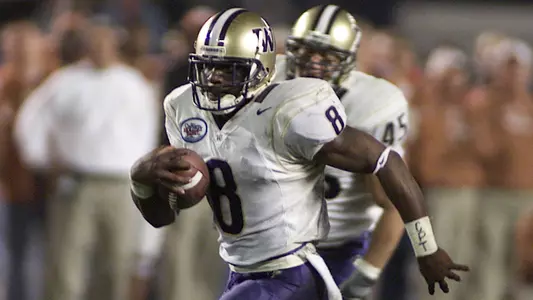
Husky Legend: Willie Hurst
September 16, 2017 | Football
By Kimberlie Haner
From injuries to position changes to coaching changes, Willie Hurst had a unique challenge during his time playing football at Washington from 1998-2001. Despite the hurdles, he rose to the challenge and became a Husky legend.
Born in Long Beach, Calif., Hurst was one of seven siblings. He grew up a fan of Washington football. He went to high school in Compton, Calif., and at this time, the Huskies were one of the premier teams in the Pac-10.
"I always liked the brand of ball that Washington played," Hurst said. "It was a run first, punch them in the mouth type of style. I absolutely fell in love with it."
When Washington came knocking to get Hurst to play in Seattle, it was a no-brainer. His first letter from UW was hand-written, which made him realize that they really wanted him there. His official visit happened on an odd day because it was one of those rare snow days in the Pacific Northwest.
"It actually snowed pretty badly," Hurst said. "They thought they lost me because of that, but it didn't detour me at all. I was so in love with the program."
While being recruited, Hurst was promised that he could make an immediate impact, and he did. In the fourth game of the 1998 season against Arizona, he took over as the starting running back. He led the team in rushing as a true freshman and set the new freshman single-season rushing record with 604 yards.
He followed up a strong freshman year by leading the Huskies in rushing again during his sophomore season, tallying 546 yards. That year, 1999, Rick Neuheisel was hired as the new head coach at Washington, bringing with him different ideas for where Hurst could be successful. Despite his success rushing, Coach Neuheisel moved Hurst to the receiving core during spring ball.
"I actually thought about transferring after my sophomore year after being moved to receiver," Hurst said. "It threw me for a little while."
Hurst was on the brink of leaving when his dad talked him out of it. Instead of avoiding the difficult situation, he talked to Neuheisel about turning back into a running back. Hurst was told he would be fourth on the depth chart, anticipating that an incoming freshman would be more productive. He then asked Neuheisel if he would have the opportunity to move up.
"He (Neuheisel) said I would have every opportunity to move up if I showed him something," Hurst said. "After that, I was on a mission to prove to him I had what it takes to be a polished running back."
This experience was the biggest hurdle he jumped during his career at Washington. Hurst feels like this was how he grew the most, how he became not only a better football player, but also a better person.?
"You can run or you can stand there and fight," Hurst said. "I chose to fight."
Hurst's hard work paid?off as he made national ?headlines during his junior? season. Despite not starting?against Arizona, he had two?fourth-quarter touchdowns,?including one for his highlight?reel. The first was a 65-yard?scamper to start a 15-point,?comeback rally. He later ran for 23 yards to reach the endzone, spinning to avoid the defender. That play, affectionately called "Willie's Whirl", earned him CNN/SI.com's "National Play of the Week."
Washington played its way into the Rose Bowl against Purdue that season. A lot of the wins in 2000 were comeback efforts, so the team felt that they were not getting as much respect in the national polls. However, through a "real team effort", as Hurst put it, they were still able to kick down the door and get to the Rose Bowl.
The Huskies' 34-24 win was their first bowl win since 1997 and is the last time Washington has been to the Rose Bowl. Hurst came ready to play. He scored a touchdown in the fourth quarter to seal the win for Washington. In that game, he carried the ball nine times for 53 yards and a touchdown.
"As a kid from California, I've watched the Rose Bowl countless times," Hurst said. "The Rose Bowl is the National Championship on the west coast. It was an awesome experience. We beat (Purdue's quarterback at the time) Drew Brees!"
Hurst finished the season second on the team in rushing yards with 402 on 66 carries, setting the stage for a fantastic final encore. As a senior in 2001, he got back to work, finishing the year with 744 rushing yards. In his career, he had 25 rushing touchdowns, good for 10th all time. He also ended with 2,334 career rushing yards, which put him in 14th place all time at Washington.
At the season's end, the team recognized his efforts and his importance to the squad's success. At the team banquet, he was named the Offensive MVP and the Guy Flaherty Award for the team's most inspirational player. The Guy Flaherty Award is considered the top award given to a football player at Washington.
"To be named Offensive MVP was a huge thrill," Hurst said. "Being the most inspirational player is just a testament to everything I went through and my hard work. People recognized it and actually saw it."
After Hurst left UW, the path to professional football was a rocky one. Upon the completion of his senior year, he was told that he played himself into the first half of the second day of the draft. Unfortunately, he did not get any calls during free agency.
?All hope was not lost, however. While in Indianapolis for a tryout with the Colts, Hurst received a call from his agent that he could play the B.C. Lions in the Canadian Football League (CFL).
"It was a positive experience that came out of a negative situation," Hurst said. "There were seven other running backs that they brought into camp before me, and every single one of them got hurt. It was fate to have me go there."?
Hurst missed training camp, joining the team right before the first game of the season. In his first outing, he rushed for 164 yards, solidifying his role with the Lions.
However, injuries began to hinder Hurst. In the second half of his first season, he tore a ligament in his knee. In the second season, he separated his shoulder. After that, he did not play like his normal self. He decided that he was done playing football.
"I had to find what exactly I wanted to do," Hurst said. "I was able to be a normal person for once in my life. Having a job, working, raising my family and things like that."
Hurst eventually came back to the United States. He just recently received his bachelor's degree in sociology in 2014 at Washington. He and his wife have four kids and are living in Lynnwood, Wash.
Playing football was not an easy path for Hurst, however, he wouldn't trade his experience for anything.
"The comradery, the pageantry, the overall excitement of being on a team and contributing to the team's success is something you can never replace," Hurst said. "Anybody who has ever played on a team can tell you it's more than a game, more than the training."
College football, especially, is an experience unlike any other, according to Hurst.
"One thing about college that makes it so special is that everyone is from their respective place and they all made the same decision to go there," Hurst said. "You are all in the same place trying to do the same thing. You never forget an experience like that."
From injuries to position changes to coaching changes, Willie Hurst had a unique challenge during his time playing football at Washington from 1998-2001. Despite the hurdles, he rose to the challenge and became a Husky legend.
Born in Long Beach, Calif., Hurst was one of seven siblings. He grew up a fan of Washington football. He went to high school in Compton, Calif., and at this time, the Huskies were one of the premier teams in the Pac-10.
"I always liked the brand of ball that Washington played," Hurst said. "It was a run first, punch them in the mouth type of style. I absolutely fell in love with it."
When Washington came knocking to get Hurst to play in Seattle, it was a no-brainer. His first letter from UW was hand-written, which made him realize that they really wanted him there. His official visit happened on an odd day because it was one of those rare snow days in the Pacific Northwest.
"It actually snowed pretty badly," Hurst said. "They thought they lost me because of that, but it didn't detour me at all. I was so in love with the program."
While being recruited, Hurst was promised that he could make an immediate impact, and he did. In the fourth game of the 1998 season against Arizona, he took over as the starting running back. He led the team in rushing as a true freshman and set the new freshman single-season rushing record with 604 yards.
He followed up a strong freshman year by leading the Huskies in rushing again during his sophomore season, tallying 546 yards. That year, 1999, Rick Neuheisel was hired as the new head coach at Washington, bringing with him different ideas for where Hurst could be successful. Despite his success rushing, Coach Neuheisel moved Hurst to the receiving core during spring ball.
"I actually thought about transferring after my sophomore year after being moved to receiver," Hurst said. "It threw me for a little while."
Hurst was on the brink of leaving when his dad talked him out of it. Instead of avoiding the difficult situation, he talked to Neuheisel about turning back into a running back. Hurst was told he would be fourth on the depth chart, anticipating that an incoming freshman would be more productive. He then asked Neuheisel if he would have the opportunity to move up.
"He (Neuheisel) said I would have every opportunity to move up if I showed him something," Hurst said. "After that, I was on a mission to prove to him I had what it takes to be a polished running back."
This experience was the biggest hurdle he jumped during his career at Washington. Hurst feels like this was how he grew the most, how he became not only a better football player, but also a better person.?
"You can run or you can stand there and fight," Hurst said. "I chose to fight."
Hurst's hard work paid?off as he made national ?headlines during his junior? season. Despite not starting?against Arizona, he had two?fourth-quarter touchdowns,?including one for his highlight?reel. The first was a 65-yard?scamper to start a 15-point,?comeback rally. He later ran for 23 yards to reach the endzone, spinning to avoid the defender. That play, affectionately called "Willie's Whirl", earned him CNN/SI.com's "National Play of the Week."
Washington played its way into the Rose Bowl against Purdue that season. A lot of the wins in 2000 were comeback efforts, so the team felt that they were not getting as much respect in the national polls. However, through a "real team effort", as Hurst put it, they were still able to kick down the door and get to the Rose Bowl.
The Huskies' 34-24 win was their first bowl win since 1997 and is the last time Washington has been to the Rose Bowl. Hurst came ready to play. He scored a touchdown in the fourth quarter to seal the win for Washington. In that game, he carried the ball nine times for 53 yards and a touchdown.
"As a kid from California, I've watched the Rose Bowl countless times," Hurst said. "The Rose Bowl is the National Championship on the west coast. It was an awesome experience. We beat (Purdue's quarterback at the time) Drew Brees!"
Hurst finished the season second on the team in rushing yards with 402 on 66 carries, setting the stage for a fantastic final encore. As a senior in 2001, he got back to work, finishing the year with 744 rushing yards. In his career, he had 25 rushing touchdowns, good for 10th all time. He also ended with 2,334 career rushing yards, which put him in 14th place all time at Washington.
At the season's end, the team recognized his efforts and his importance to the squad's success. At the team banquet, he was named the Offensive MVP and the Guy Flaherty Award for the team's most inspirational player. The Guy Flaherty Award is considered the top award given to a football player at Washington.
"To be named Offensive MVP was a huge thrill," Hurst said. "Being the most inspirational player is just a testament to everything I went through and my hard work. People recognized it and actually saw it."
After Hurst left UW, the path to professional football was a rocky one. Upon the completion of his senior year, he was told that he played himself into the first half of the second day of the draft. Unfortunately, he did not get any calls during free agency.
?All hope was not lost, however. While in Indianapolis for a tryout with the Colts, Hurst received a call from his agent that he could play the B.C. Lions in the Canadian Football League (CFL).
"It was a positive experience that came out of a negative situation," Hurst said. "There were seven other running backs that they brought into camp before me, and every single one of them got hurt. It was fate to have me go there."?
Hurst missed training camp, joining the team right before the first game of the season. In his first outing, he rushed for 164 yards, solidifying his role with the Lions.
However, injuries began to hinder Hurst. In the second half of his first season, he tore a ligament in his knee. In the second season, he separated his shoulder. After that, he did not play like his normal self. He decided that he was done playing football.
"I had to find what exactly I wanted to do," Hurst said. "I was able to be a normal person for once in my life. Having a job, working, raising my family and things like that."
Hurst eventually came back to the United States. He just recently received his bachelor's degree in sociology in 2014 at Washington. He and his wife have four kids and are living in Lynnwood, Wash.
Playing football was not an easy path for Hurst, however, he wouldn't trade his experience for anything.
"The comradery, the pageantry, the overall excitement of being on a team and contributing to the team's success is something you can never replace," Hurst said. "Anybody who has ever played on a team can tell you it's more than a game, more than the training."
College football, especially, is an experience unlike any other, according to Hurst.
"One thing about college that makes it so special is that everyone is from their respective place and they all made the same decision to go there," Hurst said. "You are all in the same place trying to do the same thing. You never forget an experience like that."
Tuesday, June 02
Saturday, May 02
Tuesday, April 21
Monday, April 20