In Focus: Injury Forces Change To Tarr?s Coaching Style
By Mason Kelley
GoHuskies.com
Throughout Heather Tarr’s career at Washington, the softball coach has taken pride in her ability to teach the game using personal demonstrations.
She has always been able to show by doing. She is always actively involved in the process, whether she is coaching third base during games or helping with drill work in practice.
This year, though, after suffering a torn ACL, Tarr has been forced to make a change. When the Huskies open their season Friday in Las Vegas, she will be doing all of her coaching from the dugout.
“I’ve definitely had to adjust my coaching style, because I’m so hands on and physically able to demo so many different things,” she said.
Back in December, Tarr was in Hawaii for a clinic. Tarr makes the trip every year, spending four days working and a few days relaxing.
On the last day of the clinic, the coach was enjoying some time in the water.
“I was jumping waves, diving under them and they got too high,” she said. “One of the waves got me.”
Tarr landed awkwardly and, “snapped my knee,” she said. “I knew right away what it was.”
For the first time as a player or coach, Tarr had suffered a serious injury. With the Huskies’ spring season on the horizon she started to think about how her players and coaching staff would have to adjust to compensate for Tarr working in a capacity that is not “my normal self.”
After returning to Seattle, Tarr realized she was able to do many of the things she did before the injury. She asked herself if she needed to have the surgery. She decided the long-term benefits outweighed the short-term gain of declining to have the procedure.
She had surgery in January, missing a few days, including the Huskies’ youth clinic.
“I just had to learn to let it go and trust that the staff and the team was capable of operating without me,” Tarr said. “We’ve built this thing up for 12 years to be able to sustain something like this.”
With Tarr limited to how much she can do physically she has been forced to rethink how she coaches.
“It’s putting me at a different angle and it’s helping me be a better coach,” Tarr said.
Instead of being directly involved in drills, she can now take a step back and watch from a distance, get an overview of what is happening each day and how her players are developing.
“I get to see things more from a tower perspective, kind of like how Don James used to watch from the tower,” Tarr said. “He wasn’t always hands on with everything.
In addition to the way she experiences and coaches the game, Tarr now has a newfound appreciation for the work that goes on in the team’s training room. Since this is her first serious injury, the coach now has a better sense for what an athlete goes through during the rehab process.
“As a student athlete I was so lucky. I never got injured,” Tarr said. “I was never involved with any injuries in the training room. It gives me a lot of appreciation for the way things go.”
Tarr never expected to suffer a serious knee injury, but she has used the experience to become a more complete coach.
“We’ve always been strong at being able to coach our personnel,” she said. “We adapt to what we have. We adapt to our strengths.”
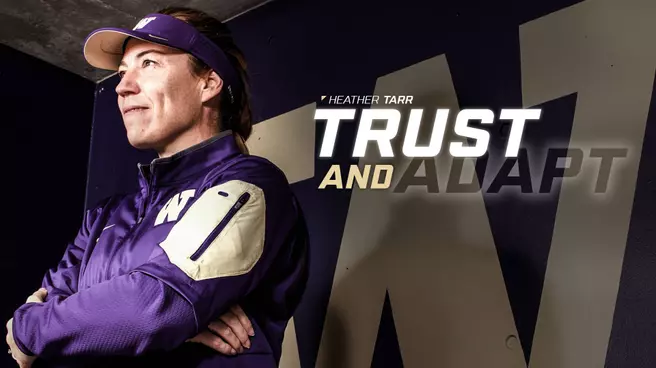
Recovering from her knee injury has just been another opportunity for Tarr to adapt. She trusted her team. She trusted her coaching staff. She trusted that a personal setback wouldn’t keep her team from having a successful season.
“It’s been challenging to come up with different ways to teach,” she said. “It’s making me a better coach.”