The Details: Name Game Creates Winning Culture For Huskies
By Mason Kelley
GoHuskies.com
After each fall camp practice, Chris Petersen gathers his team. Washington players kneel and form a half circle around their coach.
It is a time for the Petersen to deliver a few final words to his team, while also allowing other members of the staff to go over important reminders for the players.
Before breaking toward the locker room, there is one final thing Petersen asks of the Huskies. He has two members of the program stand up. One of the athletes is a newcomer. The other is someone with at least a year of experience.
Each player is expected to know the name, high school and hometown of his teammate.
If player gets the answer wrong, the team runs.
“If you don’t know their name and where they’re from at ground zero, we can’t move forward,” Petersen said. “If we make that mandatory, we start to make progress.”
As the Huskies worked their way through fall camp, studying their teammates as much as their playbooks, Petersen made his way around the roster.
Taniela Tupou patiently waited his turn. He was ready. From the moment Washington’s newcomers arrived, he made a point to introduce himself to anyone he didn’t know.
He memorized faces and names, asking each player where they were from and what high school they went to.
“Coach Pete challenges us to learn them all, so I kind of turned it into a game,” Tupou said with a smile. “Whenever I’d see them I would call them out in front of everyone, say their name, high school and where they’re from.”
He carried that idea onto the field.
“Jordan Miller,” Tupou shouted when he saw the freshman defensive back in uniform on the Husky Stadium turf. “Oceanside High School. Oceanside, California.”
Tupou spent so much time practicing, when his name was finally called, he didn’t hesitate with an answer. Unfortunately, one of his teammates got the answer wrong, and the Huskies lined up to run.
Before sprinting across the field, Tupou issued a challenge to Petersen.
“Hey, double or nothing I will name every freshmen,” Tupou said.
Petersen didn’t take the bet, but in a team meeting later that day, Tupou once again told his coach he could name the newcomers.
“I can name every freshman, trust me,” Tupou said.
Petersen was curious, so he had Tupou stand up in front of his teammates.
“At first I was kind of nervous, but I just remembered the games I played out here on the field,” Tupou said. “I pictured them with their number and face.”
He named them all.
“I was extremely impressed,” Petersen said.
Learning little things like high school and hometown might not sound like the secret to success on the field, but embracing these details is a pivotal part of the culture that is weaving its way into the fabric of Washington football.
“As a senior, you try to make this program better than when you got here,” Tupou said. “This is the future right here, so if you build them up, teach them the way, the culture, these are the guys who are going to go on and win Rose Bowls and national championships.”
Now in his second year with Washington, Petersen’s Built For Life philosophy is becoming so ingrained among the Huskies players have even started to find their own ways to push the principles.
One of the driving forces pushing the program forward is the idea that teammates, regardless of position group, need to know, and like, each other.
“He puts it on us to get to know our teammates, where they’re from,” sophomore receiver Dante Pettis said. “What they like. What they dislike. It’s cool, too, because in high school I probably wouldn’t have hung out with D-linemen.”
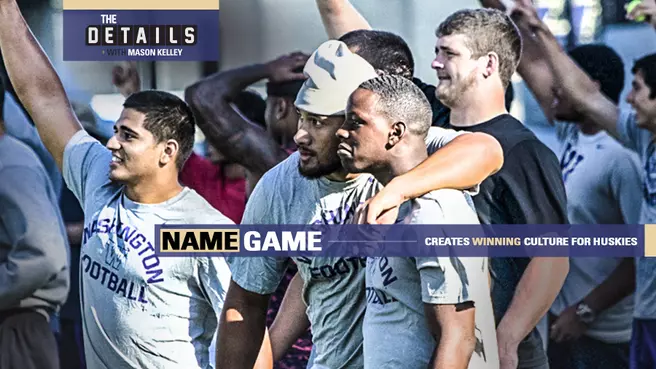
Washington calls the process of bringing players from different position groups together through bonding events called “cross-breeding.” The most popular way for the program to fuel these interactions is through the Husky Olympics.
“It’s part of the whole cross-breeding mentality,” Petersen said. “It forces guys, at a minimum, to talk to each other. The more they do that, the more they’re going to actually know each other. The more they know each other, the more they will probably like each other.”
Washington’s athletes were divided into teams that competed in everything from dodgeball to a home run derby with tennis racquets and tennis balls.
“It’s a bigger thing that just playing some silly games,” Petersen said. “We have fun with them. We laugh. We compete, but we also, in the long run, get to be a closer team.”
Talk to any player on the roster and the response is the same. This group is close. They are having fun. They are creating a culture that is solidifying the program’s foundation.
“You can see everybody is buying into the system,” senior tight end Joshua Perkins said. “Everybody is having fun with each other, mingling with each other. There aren’t any cliques on the team. Everyone’s together.”
For Washington’s seniors, the goal is to leave the program in a better position than when they arrived. For the freshmen, the idea is to learn and acclimate in an environment that is conducive for long-term success.
While the results are tangible, this is a process. It takes time build a culture. But every goal needs a starting point. Sometimes all it takes to establish a foundation is to learn little things about teammates, their names, where they went to high school and where they grew up.
Coach Petersen challenged his players to learn these basic facts about their teammates. Taniel Tupou listened. He learned the names. The senior set an example his younger teammates can follow.