Pan's Memorable Final Round Ends One Shot Short
Live Scoring
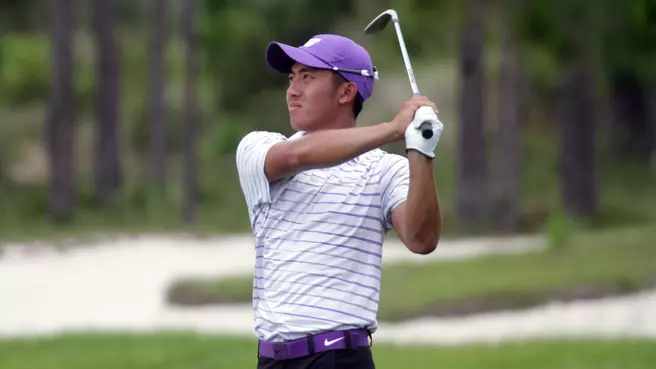
BRADENTON, Fla. – It should be no surprise that the final round of Husky great Cheng-Tsung Pan’s career would be memorable. The senior put on a clinic at The Concession Golf Club, nearly coming all the way back to win the NCAA Individual Championship. Instead, Pan settled for second place, but left a gallery buzzing after witnessing golf played at the highest level.
Pan entered his final round at 2-under, five shots back of Bryson Dechambeau of SMU who would go onto claim medalist honors. After two holes, it looked as things were finished as Pan made a pair of bogeys, looking uncharacteristically unfocused.
Normally in complete control of his game, Pan admitted he was still upset after the Dawgs fell in a playoff for the final spot in the team competition in the morning.
“My first two holes, I was moody,” said Pan. “My mentality was not tough. I was still upset that the team was defeated and I did not do my part. Those first two holes, my mind was wandering.”
Pan got things on track on the third hole. After hitting his drive into a fairway bunker, Pan advanced his second on the par five to about 180 yards. From there, Pan found the center of the green and rolled in a 20-footer for birdie. It would be his longest make of the day and begin a run of golf that won’t soon be forgotten.
“The birdie on three pulled me back,” said Pan. “After that I felt like I was rolling.”
Rolling indeed. Pan played his final 16 holes at 7-under, making seven birdies without a bogey. It was an unthinkable stretch at Concession where teams had fits all week.
After his birdie on three, Pan made three pars and then birdied 7,8 and 9 on the way to a front nine of 2-under 34. The birdie on seven was the result of a long drive and aggressive second on the par five to get just short of the green. His birdies on both eight and nine came after hitting irons close and making short putts.
Turning to the back, Pan was still well off the lead. Dechambeau got to 8-under and posted that number, playing several holes ahead. After good looks at birdie on 10, 11 and 12, Pan finally converted on 13. Finding a fairway bunker on the par five, Pan blasted a fairway metal that ended up pin high, but well left on a downslope from a tight lie. His next shot was the first in a series of special swings, knocking it close to the pin and getting it to check. He’d make that birdie to get the final stretch started.
His next shot would come from the tee of the 224-yard, par-three 14th. Pan chose 4-iron, which would prove wise as he’d come an inch from a hole-in-one. The gallery exploded as the ball rolled right next to the hole and stopped six inches from the cup. He’d tap in and move to within two shots of Dechambeau’s lead.
On 15, Pan again found the fairway bunker and played his second to the back of the green. He did well to two-putt and make par.
On 16, Pan took an aggressive line off the tee, cutting the corner on the dogleg left, but also bringing water into play. His tee shot was precise, leaving another birdie opportunity. Pan hit it to about 10 feet, but the putt rolled by, leaving a tough par-saver coming back. Pan would calmly knock that in, displaying incredible poise that manifested every time he made the slightest mistake by coming right back on the next shot to fix it.
That left two holes to play and Pan needing birdies on both to get into a playoff. Off the 17th tee, Pan again found a fairway bunker and was forced to layup on the par five. The back pin made for a difficult approach as it was fast off the green with anything past the pin. In the air, Pan’s approach appeared to be too long, but miraculously he got it to check right at the hole against the slope. He’d make that putt to get to 7-under and move to the 18th, needing a birdie to tie.
The 18th was the same hole where the Huskies team chances came to an end as Pan made bogey in the playoff. This time, Pan would split the fairway with a long drive to give himself a look at a near impossible pin on the far right on top of a knoll. Pan had 169 to the pin with water lurking right.
“It wasn’t a yardage I really like,” said Pan. “I was in between clubs, so I chose an 8-iron. I tried to hit it hard. That was the best chance I had, a seven would have been a tough shot. That is a tough hole location to get close to.”
His shot would miss just right, finding the greenside bunker, meaning he’d need to hole the sand shot to tie Dechambeau. After the round, Pan would call the bunker shot a 1/100 chance and one ‘you’d need to get lucky’. Well, it was nearly the one in a hundred because Pan’s bunker shot headed straight at the hole and lipped out as the large crowd that had gathered around the 18th green let out a loud gasp.
Pan’s chances of a title disappeared, but the golf he was playing almost made that irrelevant. After trying to make the bunker shot, Pan had a long par putt coming back up the hill. It seemed insignificant with the championship out of reach, but in complete Pan fashion, he refocused lined up the putt and drained it.
His round of 67 would tie for the best of the tournament and give him solo second place. Pan joins Husky greats Nick Taylor (2008) and Troy Kelly (1999) as NCAA runner-ups. James Lepp (2005) remains the only Husky to win an individual national title.
His Husky career is now over, but Pan gave a lasting memory for the gallery, including his teammates who walked the entire round as spectators, and the folks watching at home of the Golf Channel.
“The day was up and down a lot. I enjoyed the way I played and am satisfied how I finished,” said Pan. “I played really aggressively and happy with the way I finished the final round of my amateur career.”
Pan will now turn pro, beginning with an attempt to qualify for the U.S. Open next week at Suncadia’s Tumble Creek. He’s already earned status on the Canadian Tour and will play there this summer as he tries to move up to the Web.com and eventually PGA Tour in the coming years. A promising pro career awaits, but its clear Pan will always remember his college experience at UW.
“I always describe the last four years as the best four years of my life. I have no regrets. The last four years, I have done everything I wanted. I have been so lucky to have great teammates, great coaches and to be able to represent the University of Washington. Living in Seattle is a place I always wanted to be. Looking back on these four years, it really is the best four years of my life.”