The Details: Shelton Succeeds With A Chip On His Shoulder
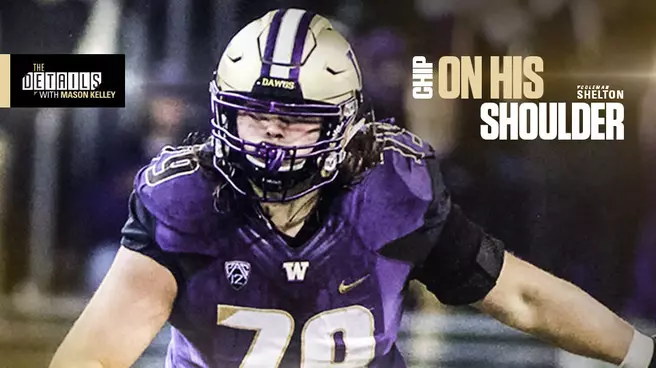
By Mason Kelley
GoHuskies.com
For the first two years of Coleman Shelton’s college career, he watched and learned. He paid close attention to Colin Tanigawa, one of his older teammates at Washington.
The offensive linemen were high school teammates. Shelton appreciated the way Tanigawa played the game. He followed the example set by his good friend and teammate.
“I always looked at him in practice, saw what he did and tried to be just like him, because I felt like he was a good role model,” Shelton said.
The solid base provided by Tanigawa showed Shelton that succeeding on the offensive line required more than strength and talent. Now a redshirt sophomore, Shelton has spent each year with Washington working to know, “what everybody is doing on the field and how they’re supposed to do it.”
His job is knowing his assignment, while “paying attention to everything.”
He studies football like it’s his major. He treats it like another class. He is as focused in meetings as he is in games or on the practice field.
“You kind of have to treat it like a job,” he said. “You’ve just got to study your work, study your plays. You’ve got to know everything.”
Coming out of Loyola High School in Los Angeles, Shelton was a late addition to Washington’s recruiting class in 2013. He believed he had the talent to play at a high level in college, so when he arrived in Seattle, he brought with him a rather large chip on his shoulder.
“I wasn’t really a highly recruited guy coming up,” Shelton said. “I always felt like I should have been more sought out. I always had a chip on my shoulder and wanted to prove something.”
After redshirting his first year, Shelton played in 13 games last season, starting seven. After a year at right tackle, he has been asked to play a variety of positions as a sophomore this season.
“He knew that was one of the values he brought to this team coming into fall camp,” Washington offensive line coach Chris Strausser said. “He has played some different spots. There’s different little tweaks that go from one spot to another, certainly going from tackle to guard is very different, but sometimes going from left side to right side adds some new challenges, too.”
Shelton started the first two games of the year at left tackle. He started two games at left guard and has been at right guard the past two weeks.
“It’s a really big factor in being a starter, being versatile, wanting to be on the field no matter what position,” he said. “It doesn’t matter if you want to play tackle, or if they throw you in at guard.”
As far as Shelton is concerned, a successful offensive line needs athletes who aren’t focused on a specific position.
“It’s about where you fit in best in the puzzle that is the offensive line,” Shelton.
It has been a challenge, but Shelton has been up for it.
“He’s never flinched,” Strausser said. “He’s been up for whatever we’ve needed him to do. He’s gone in there in many of the games and graded out the best, despite the fact that he really hasn’t played the same position more than two games in a row.”
Even though he started his career at tackle, Shelton made sure to learn every aspect of the other positions along the line. Now, when he’s asked to switch spots, his piece of the puzzle fits seamlessly.
“The more you learn, the more you remember,” he said. “Each position gets easier as it goes along. You kind of just starting knowing what to do for every position that you play.”
As impressive as Shelton has been, he is playing at a high level despite missing months of offseason work in the weight room while recovering from an injury. Like switching positions, he doesn’t complain or make excuses.
“He’s the type of guy we want on this team,” Strausser said. “He’s more about the team than what would maybe be best for him. The more guys we get like that, the more guys we have like Coleman who are willing to jump around to different spots and never complain, those are the types of guys we want around here.”
But, as important as Shelton has become to the Huskies’ offensive line, he still goes to work (practices and games) every day with a chip on his shoulder.
“I still feel like I haven’t proven anything,” he said. “I still have to go out and compete as best I can, do the best I can. Once this team, and everyone, does great then I feel like I can prove myself. I’m just trying to help the team right now.
“I just have to keep getting better, keep studying and working on my offensive technique.”