Unleashed: My Favorites in the Class of `13. And Beyond
June 12, 2013
By Gregg Bell
UW Director of Writing
Click here to receive Gregg Bell Unleashed via email each week.
SEATTLE - Please, help me out here. I can't figure out which graduating Husky to congratulate more.
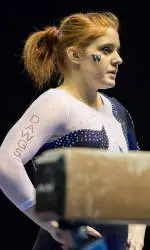
Kylie Sharp? She's just the only college athlete known to have competed with two liver diseases, that's all. She delayed her overdue liver transplant to be on Washington's gymnastics team. The Pac-12 Student-Athlete Advisory Committee as the 2012-13 recipient of the conference's Sportsmanship award. She will walk in UW's main commencement ceremony Saturday at CenturyLink Field as the first in her family to receive a college degree, in anthropology.
How about Kari Davidson? Washington's starting goalkeeper through 2012 was supposed to graduate last June with her degree in visual communications design. But she was too busy co-founding Haiti Babi, the non-profit she started. She and Seattle commercial real-estate agent Katlin Jackson have employed and are empowering Haitian mothers, moms who haven't had the means to care for children they have had to send to orphanages on the impoverished Caribbean island. Davidson also has already completed a design internship at Microsoft, which subsequently hired her to a full-time position.
Last month my wife and I attended a poignant fundraiser near University Village to keep Haiti Babi's momentum surging. When I jovially remarked how she's already changing the world, Davidson's eyes widened.
"I can't believe I haven't even graduated yet!" she gasped.
How about Charlie Hughes? A few weeks after he helped get UW back to the NCAA men's golf championships with a career-best round in a regional in Florida, the British Columbian will graduate while on the dean's list for the fourth time in four years at UW. He entered the final weeks of his academic career with a 3.59 grade-point average. Two weeks ago Hughes became the first Husky to be named to the first or second Pac-12 all-academic golf team in three different years. He is an active member of the Washington Student-Athletic Advisory Council. He is also a member of UW's acclaimed Foster School of Business, about to get a degree in operations and supply-chain management. Like his father has outside Vancouver, B.C., Charlie wants to start his own business, potentially in golf.
Then there's Christine Babcock. After returning last week to the NCAA national track championships, the standout distance runner is graduating with a degree in early-childhood education and family studies. Babcock's GPA is a mere 3.93 - she must have been running on extra-long workouts that cost her that other .07 - and she's been a recent Pac-12 scholar athlete of the year for cross country. She hopes to continue running, as a professional, for at least another year and then go to graduate school to become an occupational therapist.
Like his track teammate Babcock, Jeremy Taiwo was also named this month to the Capital One academic all-district team for track and cross country. That makes them eligible for national academic honors. Taiwo has a 3.54 GPA and will receive his degree this week in Latin American studies, with a minor in global health. He wants to work at a non-profit to provide preventative care and education on local, grass-roots levels in a Spanish-speaking community. He is also contemplating a stint in the Peace Corps.
That won't happen immediately after he tosses his graduation cap into the Seattle air on Saturday, though. Last week Taiwo - who has competed with one arm while injured and then overcome ligament-replacement surgery in his elbow that cost him a year-plus of competition - smoked his 10 events at the NCAA track championships in Eugene, Ore. He finished second with 8,239 points, the eighth-most decathlon points in NCAA history. That's good enough for the "A" standard, allowing Taiwo to compete not only in this month's U.S. Track and Field Championships in Des Moines, Iowa, but also the World Track and Field Championships in Moscow Aug. 10-18.
Wait ... I'm not done yet.
Fifth-year senior Kelcey Dunaway is graduating with a biology degree and a minor in gender, women, and sexuality studies. She leaves this week for a volleyball tour of China. Upon her return this summer, she will take the MCAT for medical school. Her teammates on UW's national-power volleyball team admiringly call her a "brainiac," and she wants to become an obstetrician/gynecologist.
But Dunaway isn't heading down that path to get rich and drive a BMW through her hometown of Bainbridge Island. Her career goal is to care for women from rural or low-income areas who often lack quality medical options.
"I really could see myself doing that," she told me Wednesday, after completing her final UW exam in organic chemistry.
Football's William Chandler is graduating with a 3.84 cumulative GPA. The Huskies' wide receiver and placekick holder, a walk-on from Skyline High School in Sammamish, Wash., earned a scholarship prior to the 2011 season. He is one of just two student recipients for accounting excellence inside UW's Foster School of Business' accounting department. It's one of Foster and UW's more prestigious honors for an undergraduate.
And you thought "student-athletes" were the exceptions in big-time college athletes, not the norm.
"WHY WOULD A FOOTBALL COACH BE HERE?
Get this: Some of the undergraduates behind these stud grads are just as impressive.
Steve Sarkisian saw that first-hand last month.
The Huskies' 39-year-old football coach looked almost presidential inside Washington's Mary Gates Hall, just off "Red Square" in the center of campus. He was standing in a coat and tie, between pillars on a second-floor balcony overlooking a convention of young professionals and UW faculty.
Ed Taylor, vice provost and dean of the university's undergraduate academic affairs, was introducing the Sarkisian during Washington's annual Undergraduate Research Symposium on May 17.
Dean Taylor asked a question of the researchers and their mentors, who were standing proudly below him and Sarkisian on the main floor of the exhibit hall, next to their poster boards and projects:
"Why would a football coach be here?"
Well, why not?
There were 11 Husky student-athletes presenting at the acclaimed symposium, representing the football, crew, soccer, softball, and tennis teams. There were also 18 anthropology students, not intercollegiate athletes, presenting their findings on studies of sports and culture.
Thomas Tutogi was on the right side, in the middle of the exhibit hall, a few feet in front of Scott Woodward, the UW director of athletics who was sampling the presentations. Tutogi's project was placed next to one examining the role of basil ganglia in autism spectrum disorder (yeah, I had to look it up, too).
The ball-hawking linebacker, who is entering his senior season this fall, was standing proudly in a pale yellow dress shirt, slacks and saddle shoes. His long hair was pulled back into a ponytail as he explained how he used interview analysis, photographic analysis and participant observation to determine what Nike looks for in the athletes it signs to endorsement contracts.
(Tutogi concluded that superstar athletic achievement - and little else - determine the company's targets).
How big a deal was presenting at the symposium for Tutogi, a transfer from Southwestern Junior College in Chula Vista, Calif., that you know more for the career-high 12 tackles he put on No. 3 LSU in Baton Rouge last September? His father flew up from San Diego to see his son's presentation. He walked through the hundreds of project posters wearing a Chargers hoodie and a proud smile.
"This is the first time we've had the football coach here at the symposium," Taylor, the dean, told me as we watched the Tutogis talk at Thomas' poster site. "And how great is it that his dad is here?
"Of course he comes up for his football games. But to see him here shows what their entire college experience means to their families."
Sarkisian has the football program surging beyond the field as much or more as on it. Last fall the NCAA reported 70 percent of players in the Football Bowl Subdivision who were who were freshmen in the2005-06 academic year graduated, according to its graduation success rate (GSR) measure.
Only Stanford and Washington exceeded that 70 percent graduation rate inside the Pac-12.
"We have the number two graduation rate in all the Pac-12, and we have the highest GPA our football team has ever had in the history of the program," Sarkisian told the student researchers at the symposium.
Then the coach told the story of one of the best academic accomplishments of Sarkisian's four years leading Husky football.
John Timu was a featured presenter at the symposium. He and teammate Hau'oli Jamora got their own, second-floor room and 12-minute, afternoon block. They gave a verbal and visual presentation of their project examining why our society doesn't accept football intelligence as correlating into real-world intelligence -- though it makes a similar correlation for intelligence in, say, chess.
One of the handful of defensive players in recent UW history to be named a captain as a sophomore, Timu is the first in his family of two parents and four children to attend college. This spring the middle linebacker won Washington's prestigious Brett E. Baldwin Memorial Scholarship for Anthropology. Timu is the first UW student-athlete to ever win the scholarship.
He came to Washington from Long Beach Jordan High School in southern California, an urban school that has a student body of 4,200-plus, 97-percent of which is non-white.
Timu's project - and his 3.20 GPA in winter quarter plus 3.14 cumulative GPA while starting 21 of his first 25 games as a Husky - are challenging our perceptions and stereotypes that accompany his background.
"John Timu, he was a special admit," Sarkisian told the symposium.
That's the term for student-athletes whose academic credentials must be screened by an extra academic board and viewed as much for their potential than their accomplishments in order to gain admission into UW.
"He has truly taken on and flourished in the opportunity that's been put before him," Sarkisian said of Timu. "It's a pleasure and an honor to be here and share in this experience with him and with you."
A couple hours later, Timu and Jamora, a junior defensive end from Hawai'i who is also of Pacific Islander heritage, walked into room 228 of Mary Gates Hall. They were featured presenters in Session 2C, Education and Social Inequalities. They articulated their findings of "Decolonizing Education: Translating Football Intelligence into the Classroom" to Judith A. Howard, a professor and divisional dean of social sciences in UW's College of Arts and Sciences.
The football players began their presentation accentuating the stereotypical jock, wearing their dark purple, Huskies lettermen's jackets with the gold, varsity W sewn into the fronts. But near the end, after a few nervous pauses in their entertaining presentation, they simultaneously shed the jackets to reveal dress shirts and slacks.
Then they each put on clear-lens eyeglasses. That amplified the crux of their research.
"Do I have to take off these jackets and put on glasses to be seen as intellectual?" Timu asked the audience of fellow student-presenters and UW faculty, plus staff from the Huskies' Student-Athlete Academic Services (SAAS) office.
"This is a start. This is a gateway for people to be able to show their intelligence (rather than disprove perceptions)."
The audience loved it.
"Very cleverly done," one of the moderators assisting Professor Howard told the Huskies. "Really interesting."
Outside the room, the two bedrocks of the Huskies' defense looked as if they had just spent the day chasing down Oregon Ducks all over Eugene.
"It's not my realm," Jamora said of public speaking, with a sigh. "It will be, though."
Timu was smiling, seemingly as satisfied as he was relieved that the presentation was over.
"We wanted to entertain a little bit," he said. "It was nerve-racking - but a great experience."
THE BEST OF STUDENT-ATHLETES
I have a clear take-away from this graduation week, and from last month's research symposium for those who will soon become graduate themselves. The games these student-athletes play give them national exposure and team-camaraderie and, in many cases, status as social heroes. In turn, they give us thrills and entertainment and passion for sports, plus rallying point back to campus.
All the other, unseen and countless hours and weeks and months these Huskies spend as students? In those times they are no different than any other of their peers pursuing a degree from one of the nation's top public universities. They strive to excel.
It's like Davidson told me at that Haiti Babi Mother's Day event last May: Can you believe they haven't even actually graduated from college yet?
The best ones aren't necessarily those who win Heisman Trophies or Final Fours or national titles. The very best are like Timu, like Hughes and Sharp and Davidson and these fellow graduates. They use athletics to take absolutely full advantage of the entire college experience, to succeed in establishing a strong basis for something far more lasting and important than games.
For life.
And when they do, they are like Tutogi and his father. They are fulfilled and they are proud - I suspect more proud than from any of their wins or scores or results we see on TV or in game recaps.
That is what college should be about.
About Gregg Bell Gregg Bell is an award-winning sports writer who joined the University of Washington's staff in September 2010 as the Director of Writing. Previously, Bell served as the senior national sports writer in Seattle for The Associated Press. The native of Steubenville, Ohio, is a 1993 graduate of the U.S. Military Academy at West Point, N.Y. He received a master's degree in journalism from the University of California, Berkeley in 2000.
Gregg Bell Unleashed can be found on GoHuskies.com each Wednesday.
Click here to email Gregg Bell.
Click here to visit Bell's Twitter page.