Washington Announces 2004 Hall of Fame Inductees
May 12, 2004
Seattle - The Washington Big W Club announced the class of inductees for the 2004 Husky Hall of Fame today. The group of five individuals and one team will formally be inducted into the Hall of Fame on Friday, Nov. 5 in a ceremony that will be held at Bank of America Arena at Hec Edmundson Pavilion. The class will be introduced during halftime of Washington's Nov. 6 Homecoming football game against Arizona.
This year's class includes former football standouts Napoleon Kaufman, Lincoln Kennedy and Jeff Jaeger, women's basketball player Rhonda Smith, former swimming coach Earl Ellis and the members of the 1970 and 71 Husky men's crew team.
"It's a blockbuster class," said former Husky All-American tailback Greg Lewis, who directs the Big W Club. "Hopefully we'll have enough room for everyone who will want to attend the event. Kaufman, Kennedy and Jaeger are some of the most well-respected and liked former Husky football players. Earl Ellis had a tremendous impact on hundreds of former student-athletes in the swimming program. Rhonda Smith is just a legend in this town when it comes to basketball and the 1970 and 71 crew teams are long overdue for this recognition. This class is a great reflection of the overall outstanding tradition of Husky athletics."
Former senior associate athletic director Don Smith will be presented the Dr. Don Palmer Award for his contributions to the Husky athletic department.
Earl Ellis
 Under the direction of coach Earl Ellis, the Washington swimming programs enjoyed their most successful seasons. Ellis spent 20 years with the Husky program, including 19 as the head coach before retiring in 1998. He directed the men's teams to a record of 215-45 (.827) in dual meets and was responsible for starting the women's team and guiding it to a 206-29-2 (.873) record. Ellis coached 36 men's All-Americans, 25 women's All-Americans, seven Olympians (including three medalists) and six national champions. A native of Mount Vernon, all three of his children swam for him at Washington. His teams won three Pac-10 titles and had seven top-11 finishes at the NCAAs from 1970-78.
Napoleon Kaufman
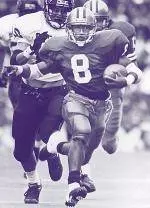
 Washington's all-time rusher leader, Kaufman finished his four-year career with 4,401 yards. Kaufman played for the Huskies from 1991 to 1994. He set the Husky single-season rushing record in 1993 with 1,299 yards and better it as a senior with 1,390 yards. Kaufman also rushed 1,045 yards as a sophomore to stand as the only UW player to have three 1,000-yard seasons in a career. Kaufman became just the fifth back in Pac-10 history to piece together three consecutive 1,000-yard rushing seasons and he was only the 40th rusher in NCAA history to eclipse the 4,000-yard mark in a career. Kaufman was a three-time All-Pac-10 pick and a second-team All-American as a senior. He was taken by the NFL's Los Angeles Raiders as the 17th pick in the 1995 draft. His six-year NFL career was spent in Oakland where he rushed for 4792 yards. After he retired from professional football, he founded the Crucified with Christ Ministry and the Napoleon Kaufman Foundation in Alamo, Calif. Kaufman was a drama major at Washington.
Lincoln Kennedy
 Lincoln Kennedy was the only unanimous first-team All-America pick in 1992 among Pac-10 players and the top offensive tackle in the nation his senior season. The Husky offense averaged 387.6 yards-per-game largely due to his blocking. He was also a two-time first-team All-Pac-10 pick and Pac-10 Morris Trophy winner (top offensive lineman). Kennedy was one of four finalists for the Lombardi Award and a semifinalist for the Outland Trophy. He allowed only two sacks in his four years at Washington and was the ninth player selected in the 1993 NFL draft as a first-round pick of the Atlanta Falcons. He played there for three seasons before joining the Oakland Raiders in 1996 until he retired following the 2003 season. He was named to the Pro Bowl three consecutive seasons from 2000 to 2002. Kennedy was a drama and speech major at Washington.
Jeff Jaeger
 Jeff Jaeger is the all-time Husky scoring leader with 358 points. During his career he set a NCAA record with 80 career field goals. He connected on 17-of-21 field goal attempts and 42-of-43 extra point attempts in his senior season to earn first-team All-America honors. He set Washington's single-game record with five field goals against Houston in 1985. He made 20 field goals as a sophomore and 22 during both his junior and senior seasons. Jaeger made 80 of the 99 field goals (80.8 percent) he attempted during his career. Jaeger was selected by the Cleveland Browns in the third round of the 1987 NFL draft. He later played for the Los Angeles/Oakland Raiders and Chicago Bears. During his 11-year professional career he scored 1008 points and converted 74 percent of his field goal attempts. He led the NFL in scoring and field goals in 1993 and was a Pro Bowl selection in 1992. Jaeger is a native of Kent and was a sociology major at Washington.
Rhonda Smith
 A Seattle native, Rhonda Smith was a standout for the Husky women's basketball team from 1992-1995. Washington went 80-40 during her career, including a 25-9 mark her senior season. During her four-year career Smith scored 2,948 points and pulled down 803 rebounds. She finished her career as the all-time scorer and third-leading rebounder leader Smith led the team in rebounding during each of her seasons and was UW's scoring leader her final three years as a Husky. Smith was the Huskies' most accurate shooter every year she played, the only Washington player to do that. As a senior she guided the Huskies to the preseason National Invitational Tournament championship by scoring a career high 38 points in the finals at Texas Tech. It tied as the second highest point total in Washington history. A three-time All-Pac-10 pick, Smith was named to the District VIII All-America team as a junior and senior. She was a founding member of the Seattle Reign and became the first Washington player drafted by the WNBA. She majored in psychology at Washington.
1970 & 1971 Crew
The Washington men's crew teams from 1970 and 1971 included three future Olympians and two others who competed at the World Championships. The 1970 Varsity 8 team defeated heavily favored Pennsylvania for the Intercollegiate Rowing Association national championship under the direction of coach Dick Erickson. It was Washington's first Varsity 8 national title since 1951. Four members of that team went on to claim the 1970 National Association of Amateur Oarsmen (NAAO) Four-with coxswain title. The 1971 squad placed second at the IRAs, but rebounded to take the Eight crown at the NAAO championship. Representing the United States at the 1971 Pan American Games, the Huskies brought home a silver medal. It marked the last time a college crew represented the United States in major international rowing. The individuals who rowed for both teams included Cliff Hurn (stroke), Greg Miller and Rick Copstead. Larry Johnson, Brian Miller, Brad Thomas, Chad Rudolph and Mike Viereck rowed for the 1970 team that included coxswain Jim Edwards. The 1971 team featured Jon Buse, Charles Rutherford, Fred Schoch, Bruce Beall, Pete Suni and coxswain Dwight Phillips. Rex Thompson was a spare on that team who competed at the Pan Am games. Rutherford and Rudolph went on to compete at the 1972 Olympics in Munich. Beall was selected for the 1984 Olympics in Los Angeles. Beall, Hurn and Phillips were a part of the 1973 World Games in Moscow.
Don Smith, Dr. Don Palmer Award Winner
The Big W Club's most prestigious award, the Don H. Palmer Award, was created in 1994 to recognize Dr. Palmer's outstanding contributions to the UW Athletic Program as the unpaid athletic team physician from 1904-1947. He was a founder of the Big W Alumni Club, the Homecoming halftime Blanket Parade and the 101 Club. The 2004 recipient of this award is Don Smith, who was an administrator at Washington from 1971 to 1995. Smith helped to oversee the support operations of the athletic department and is credited with helping to solve the department's racial problems during the early 1970s.