Shellhouse Renovation to Benefit More Than Husky Rowers
May 20, 2003
Seattle, WA - In 1909, legendary rowing coach Hiram Conibear converted a structure that served as a lighthouse during the Alaska Exposition into Washington's first shellhouse. It was just one of many steps the patriarch of Husky rowing took to establish the Washington rowing program into national prominence.
| Conibear Shellhouse |
| Click on images for larger view. |
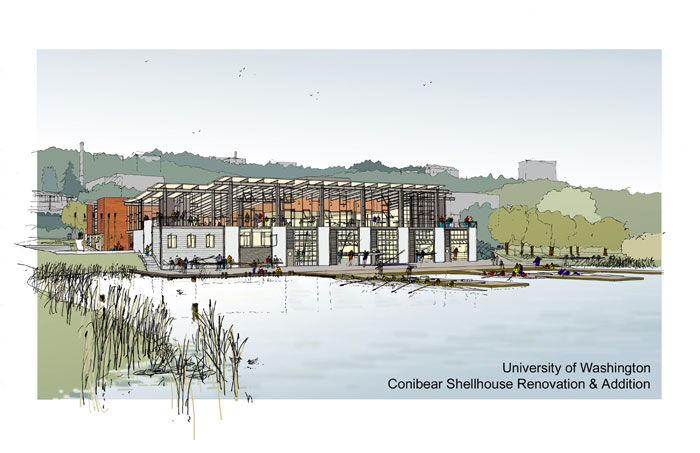 |
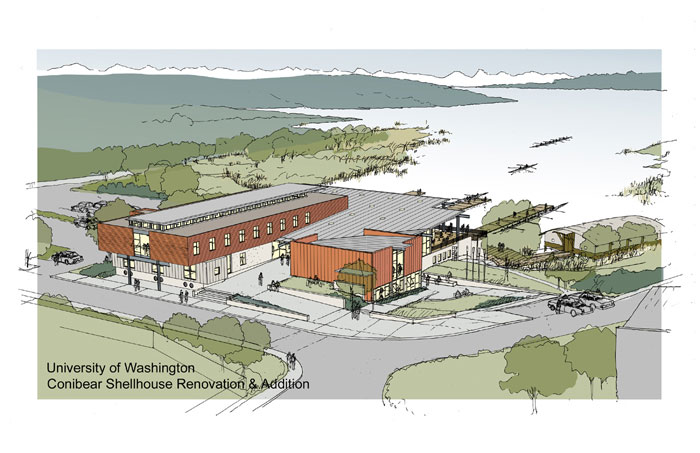 |
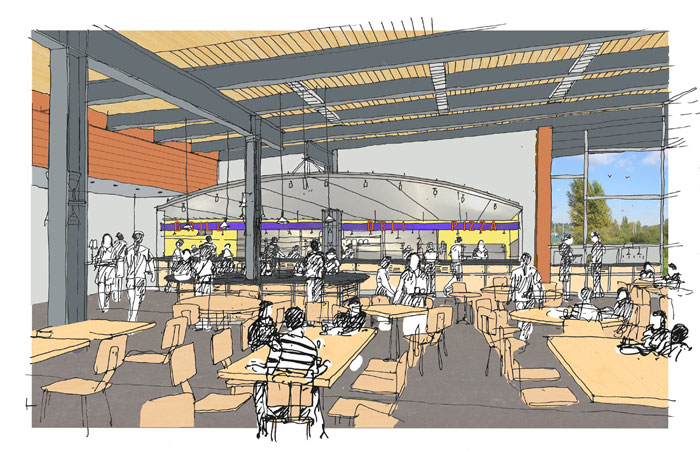 |
In 1949, the University paid homage to Conibear's 10-year term as the Husky rowing coach by naming its new shellhouse in his honor. Conibear, who is best known for revolutionizing the sport by pioneering a new stroke, was also a masterful fundraiser who dedicated his life to teaching. The University's announcement of a massive renovation of the building that bears his name would certainly meet with his approval.
Since its opening, the Conibear Shellhouse has provided a home and training facility for Washington's men's and women's crew programs. At the same time, it has served as the athletic training table for countless Husky student-athletes, provided living quarters for UW rowers and football players for a quarter century and more recently, served as the headquarters for the athletic department's academic support services and student life center.
Today Washington athletic director Barbara Hedges announced a $18 million renovation of the Conibear Shellhouse and Student-Athlete Life Center. Pending the completion of $5.7 million in fundraising, the project is slated to begin in December of 2003 and will take 14 months to complete. To date, $12.3 million has been raised in private donations to fund the renovation.
Featuring expansive views of Union Bay and the Cascade Mountains, the renovated Conibear Shellhouse will serve as the hub of the crew program and the student athletes' campus life. Nestled in an environmentally sensitive area, the project will enhance existing natural areas while improving the pedestrian's experience on the site.
The project will expand the current structure by 60 percent to a total of 31,000 usable square feet. The area dedicated to the Husky crew program will improve from 11,100 square feet to 20,000 square feet. The Student-Athlete Life Center will grow from 4,600 square feet to 6,000 square feet. The dining hall will increase by 1,100 square feet to a total of 5,000 square feet.
The Student-Athlete Life Center is the home for several of the athletic department's support programs. Student-Athlete Academic Services offers computer labs, tutorial services, academic counseling and other classroom support services. The offices for sports nutrition, sports psychology and community service are also housed in the building. Washington's athletic compliance staff is also located in this area.
Washington's annual budget for its academic support areas is $1.1 million.
More that 250 student-athletes use the building's dining service for training table.
The renovation will provide the Husky crew program with new lockerrooms, meeting rooms, ergometer training facilities, coaches offices and expanded shell storage.
Helping keep the tradition of the original shellhouse, the renovated building will include traditions like the Captain's room and Captain's plaques, the letterwinner wall and the bronze presentations of legendary Husky coaches Conibear, George Pocock, Al Ulbrickson and Dick Erickson.
"The shellhouse may be the most important project in the Campaign for the Student-Athlete," Hedges says. "This is a facility that will be a tremendous benefit to all of our programs in terms of support for our student-athletes, particularly in the area of academic assistance. There will be no better platform to assist us in our mission to provide comprehensive support for our student-athletes.
 |
"This is a facility that will be a tremendous benefit to all of our programs in terms of support for our student-athletes, particularly in the area of academic assistance."
--Athletic Director Barbara Hedges
|
"We have made significant upgrades in our competition and practice facilities. We have greatly improved our athletic training and physician support programs. We are also in the process of upgrading and improving our strength and conditioning equipment. The renovation of the shellhouse will greatly improve our ability to provide academic support. Right now we are bursting at the seems. This project will provide us with much needed space to better serve our student-athletes."
The renovation of the Conibear Shellhouse is a part of Washington's Campaign for the Student-Athlete. To date, approximately $89 million has been raised (including $79 million in private funds) to renovate Hec Edmundson Pavilion ($42 million) and to build Dempsey Indoor ($29 million), the Huskies' multi-purpose athletic training venue. That total includes $4 million raised towards the future construction of the Husky Baseball/Soccer Complex located north of the shellhouse.
The project architect for the shellhouse renovation is Miller/Hull Partnership of Seattle. The construction will be performed by Sellen Construction of Seattle.
The National Board of Directors of The American Institute of Architects recently named the Miller/Hull as recipient of the 2003 AIA Architecture Firm Award. The annual award is the highest bestowed by the AIA. It is given annually to recognize a practice that has consistently produced distinguished architecture for at least 10 years.
Miller /Hull's designs have been identified as representing the next generation of regional modernism, also known as the "Northwest Style." This widely adopted style is characterized by a woodsy or natural theme, sharp lines and classic boxy shapes. It is applied to homes and commercial spaces through use of exposed timber, large windows and other materials inspired by the rugged landscape and evergreen colors of the region.
Miller/Hull's design for the new Fisher Pavilion at Seattle Center was one of 10 sites recognized by the AIA to receive a "Green Award" as an example of architectural and "green" design solutions that protect and enhance the environment.
Sellen Construction oversaw the work on Washington's Dempsey Indoor and the renovation of Hec Edmundson Pavilion. The chairman of Sellen is Rick Redman, a former All-American football player at Washington from 1962-64.
The site improvements will be consistent with the Campus Master Plan and will improve overall pedestrian circulation and shoreline access. No over-water work is planned.