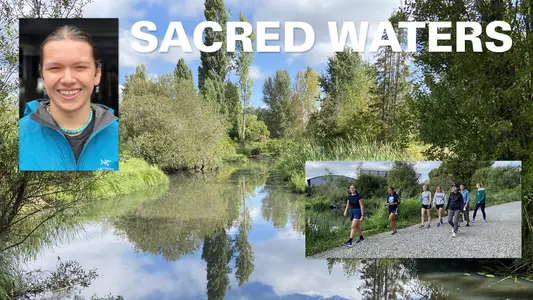
Sacred Waters: A UW Grad's Indigenous Walking Tour Enlightens Rowers
November 29, 2021 | Men's Rowing, Women's Rowing
“Sit and listen to the birds and plants that sway within the wind of the Union Bay Natural Area. Pristine and natural, isn’t it? The aromas of seasonal change are carried throughout the wetland. … Now close your eyes and imagine, you are placed back a couple hundred years … years before there were Western settlers and you feel like a guest on Indigenous land for the first time in your life.”
Standing on a bridge spanning a tributary to Union Bay, a few Washington rowers listen to these words read aloud as they follow along on their cell phones. It’s a quiet, sunny summer morning on campus. A perfect day to make their sport more meaningful by learning about the history of the waters on which they row.
The eloquence of 2021 UW graduate Owen Oliver, who authored the tour his senior year, takes the rowers through an imaginary canoe journey with a Duwamish woman whose village once stood on the footprint of University Village Shopping Center.
“Understand that this is the place called ‘Carry a Canoe’, st?x??ug?il which is no longer. The opening of the Montlake Cut in 1917 destroyed this place, lowering the water of the lake. ‘Carry a Canoe’ was shadowed by writers of history, traders, businessmen, city planners, and instead of carrying a canoe, they carried the misrepresentation of Native history forward. ... Understand that the opening of the Montlake Cut dried up the Black River, rerouted Lake Washington’s aquatic system, and changed the course of Seattle forever.”
“On the Montlake Cut, there’s a totem pole we pass every day. The Cut is sacred to us. We paint our class mottos on it. It’s where everyone comes to cheer us on. It’s our home course,” says senior coxswain Kylie Jones. “I’ve always heard the Cut described as an amazing feat of human engineering. I never really thought about what happened to the Native land. But now, I see it differently.”
Owen says that’s precisely his goal: To connect the past to the present, to awaken an appreciation for Indigenous culture and its enduring impact. As readers walk with Owen along seven stops scattered across the entirety of campus, he keeps his ancestral history alive through storytelling — none more emotionally resonant than the envisioned canoe ride at Stop 4: Union Bay.
“Everyone can have that spiritual and emotional connection to the water. It’s like a cleansing,” explains Owen, who is of Quinault and Isleta Pueblo heritage. “For the Rowing team, it’s important to be knowledgeable about Salish people. They row on ancestral lands with thousands of years of stories. If rowers think of it just as a sport, it won’t be as fulfilling as having that community and connection to the water and who you’re rowing with. By opening that relationship, they learn how to be good community members, to be more inclusive of others, and to open doors for recruiting more marginalized people to Washington Rowing.”
As a member of our Diversity, Equity and Inclusion Task Force, Owen is helping the UW Rowing program bring these values to life.
The son of the late and lauded Native American artist Marvin E. Oliver, who was a beloved Emeritus Professor in American Indian Studies at Washington for three decades, Owen also brings art into the walking tour. His grandfather Emmett earned a Master’s degree from UW in 1946 and directed the University’s Indian Student Program; his canoe hangs in the ASUW Boathouse.
As the Husky Rowers complete their tour at Stop 7: Onward, located at the HUB, their gazes rise to Raven’s Journeyon the south wall. The spectacular art piece was carved by Owen’s father and installed in 2015. A few muttered “wow’s” followed by silence reflect the impact the tour has made on the student-athletes.
“For (my father), the canoe was a metaphor of how to live your life and a mode of your own transportation. He’d always say, ‘find your own canoe and share your paddles with all’. For Coast Salish people, sometimes it’s not about saying anything. It’s about the intentions placed within our Indigenous knowledge systems. This is why the harms of Western institutions cut deeper than just what one sees upon the land itself. This isn’t just because our land was hurt, our stories silenced or assimilation tactics being forced upon us, it’s because these systemic intentions placed against us were meant to be a constant reminder that we’re less than people.”
Such hard truths have shaped Owen into the third generation of his family to seek to change minds and hearts through their stories, their art, their teaching, their belief that the next generation will work to right wrongs and keep Indigenous culture alive.
“Western society was built on the belief that there is no guilt in attempting to exterminate Indigenous knowledge systems, which in turn acted to kill us through deprivation. However, through this tour, we’ve seen Indigenous knowledge systems at their best, being revitalized by each generation of students that passes through this University. We must make sure that the passing of the information is respectful and appropriate alongside the original caretakers’ stories. Once this is done, we’ll discover that Indigenous futures benefit all.”
To download a PDF of the Indigenous Walking Tour, which soon will include a 3D map and audio narration, visit owenloliver.org.
Excerpted from the Fall, 2021, edition of SWEEP Magazine (click to read entire issue).