The Audacity of Hope
October 26, 2017 | Football
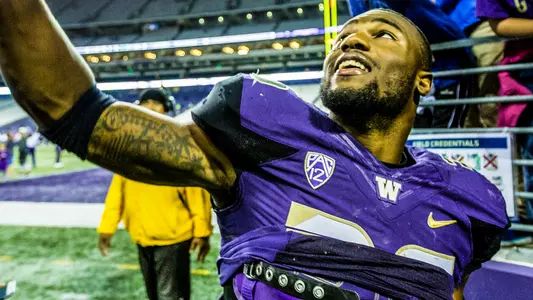
If there's one thing his teammates want to make clear, it's that Azeem Victor is not a violent man. He's funny, they say, and trustworthy ... the kind of person you want not only as a teammate, but as a friend.
The violence, though, is inescapable.
Victor's hits aren't just tackles, they're lightning strikes — fast, loud and, yes, violent, the kind of hits that make opponents think twice about crossing his zone, and make fans collectively wince in sympathy for the unfortunate recipient.
Which was what made Victor's leg injury in 2016 — the one that caused him to miss the last four games of the season — so difficult to understand. Victor is the hammer, not the nail — and the hammer doesn't get hurt.
"It was pretty sad — I've never been hurt before in football," he says, "and of course I wanted to be able to contribute to the amazing season we had. But the biggest thing was having a good support system, always having a clear mind, being positive. My family helped, and my teammates really stepped up and supported me."
You see, there's the Azeem Victor you know from watching him on the field — the one who embodies the inherent violence of the game through his speed, instincts and unmatched energy, the one who seems both fearsome and fearless, the one you don't want to see barreling towards you.
But there's another Azeem, one only his friends, family and teammates see. That's the one who cracks jokes in the locker room, who graduated on time last year with a degree in American Ethnic Studies and a grade-point-average above 3.0, the one who started his own foundation, Azeem's Dream, to help at-risk urban youth.
Lightning and hammers are strong, yes, but Victor is stronger — because he's developed the ability to turn the lightning off.
The violence was the easiest to come by.
Growing up in Compton, Calif., violence was all around Victor. An older kid in the neighborhood, Quentin Dimitris, took Victor under his wing and treated him like a brother. He showed Victor how to carry himself, how to get through the days — and how to wreak havoc on a football field like nobody's business. A middle linebacker who idolized NFL legends like Brian Urlacher and Ray Lewis, Dimitris was "an all-around beast," Victor says, channeling the anger and violence of his situation into hits that L.A. high school football observers still talk about to this day.
"Even in Pop Warner, he wore the neck roll, and I was like, 'Oooh, yeah, I like that,'" Victor recalls. "I looked up to him like a brother."
Dimitris was an inspiration for Victor, and along with his family, one of his greatest supporters; he was also a gang member. In 2013, that second side to Dimitris' character caught up to the first, when he was shot in the head on the way to his senior prom. For a kid from Compton — even one like Victor who managed to avoid the gang entanglements — violence is simply a part of life.
"He was one of my closest friends," recalls Victor, whose carries a towel with him on the field that says "Q RIP." "Now, playing middle linebacker like he did, I try to play with that same passion that he played with. He didn't get his chance, so now I try to do it for him."
As for the other side of Victor's personality — that required a little more cultivation from those around him. At the end of his junior year — already a year behind in school — a counselor sat down with Victor and his father to inform them that Victor's 1.54 GPA put him at serious risk of failing to graduate. As Victor describes it, the counselor casually said, "There's always community college."
"That was the first time that reality began to set in," Victor writes on his foundation's website. "To have someone speak that much disbelief over you hurts deeply."
More than the counselor's lack of faith, Victor says that the disappointment on his father's face cut the deepest. For the next year, he dedicated himself to proving that he wasn't a failure, that he wasn't going to wind up like so many other kids in his neighborhood; that he was going to make it — for his father, for Quentin, for himself. Working seemingly around the clock — and with the help of tutors and teachers who saw the honesty in his efforts and dedicated their time to help him achieve his goals — Victor earned his degree from Pomona High School in 2013. He calls it "the biggest accomplishment of my life."
Most importantly, the lessons stuck. This wasn't just another high-school athlete pulling up his grades to get a scholarship, then doing just enough each quarter to remain eligible. This was a sea change in the way Victor viewed the world, and his place in it. He wasn't just another kid from Compton, resigned to a life on the streets. He was a young man with a dream — and there was a whole network of people out there willing to help him achieve it ... if he was only humble enough, and brave enough to ask.
Last year, Victor dedicated himself to making sure that kids like himself — at-risk, urban youth who feel their future prospects are hopeless — are aware of the opportunities around them, launching the Azeem's Dream Foundation with help from sponsors and private donors. In addition to outreach conducted by Victor himself (including a recent backpack drive), the foundation's website, AzeemsDreamFoundation.com, includes links to free, online tutoring assistance, peer-mentor programs and other services, along with regular blog posts from the founder.
"I am committed to bring...hope to kids who are being told that they 'can't,'" Victor says. "'Hope' is a powerful, small word that carries an enormous amount of weight. [I want] to show youth that they are not alone, that dreams do come true, [and] help them realize that they can succeed regardless of their situation."
The second photo you see when you click the "media" link on the foundation's website is proof of Victor's statement. It's from this past June, and shows a 6-foot-3, African-American man in a graduation cap and gown, standing outside of Husky Stadium. He's flanked by two older women, both beaming with pride, as he clutches in his hands the one thing that 17-year-old kid with a 1.54 GPA and only two years' worth of high school credits seemed unlikely ever to possess — a college diploma.
Hope is a powerful word.
Victor, of course, doesn't have to go into the at-risk neighborhoods to find kids to impact — he's inspiring young people every single day in the UW locker room. Just ask them.
"I have a lot of trust in him, he's a great teammate," says quarterback Jake Browning, one of the few people on the roster who knows what it's like to take one of Victor's hits. "He's someone that I'm good friends with."
"Azeem is unreal," says sophomore safety Taylor Rapp, who often lines up directly behind Victor in the team's defensive formation. "He's in on basically every play. It's unreal being behind him."
"With his energy, and his aggressiveness, he makes everyone better around him," says fellow linebacker Sean Constantine, who has played alongside Victor for the last four years. "He's one heck of an athlete, one of the best I've ever seen. And he's actually a very funny guy off the field. I'm lucky I've gotten to know him."
"I can be, yeah, I'm a little funny," Victor says, chuckling, when told what his teammates say about him. "My mom would probably say that I'm crazy, and my dad would probably say that I'm a mellow dude. I show both sides."
And that's the thing about Victor — he shows both sides. He's the hopeless kid with a chip on his shoulder, the 15-year-old whose closest friend was murdered by a rival gang, the physical freak with the uncanny instincts, the force of nature whose hits are felt all the way to Husky Stadium's upper deck, the hard-working student who completed six years' of schooling in five years' time, the civic leader with an eye towards helping those less fortunate, and the ball-busting teammate who inspires respect and admiration from his peers. He's all of those things, and that's the point. No one aspect of a person's personality, no one fact of their situation, defines who they are — or who they can be. The opportunities exist, and the choices are ours — if we're simply willing to believe in ourselves. To believe in hope.