
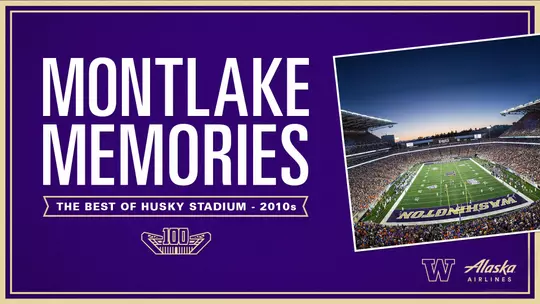
Montlake Memories: The 2010s
Husky Stadium Centennial Celebration
Jeff Bechthold
11/19/2020

With 2020 marking the 100th anniversary of the first football game at what is now called Alaska Airlines Field at Husky Stadium, GoHuskies.com is marking the milestone with a decade-by-decade look back at some of the big events that have taken place –football games and otherwise – at the Greatest Setting in College Football.
October 16, 2010 -- Washington 35, Oregon State 34 (2 OT)
The 2010 season was a big one for Washington. The Huskies had fallen on hard times in the first decade of the new millennium, but the 2010s brought new optimism. Washington hadn't played in a bowl game since the 2002 Sun Bowl, but in 2010, that streak came to an end as the Huskies earned a berth in the Holiday Bowl. The trip to San Diego was a fitting reward for the mountain that the Huskies had climbed.
But they almost didn't make that climb in 2010. After all, the Huskies finished the regular season at 6-6, the bare minimum for bowl-game qualification. The closest call of all came in mid-October against Oregon State, when the Huskies required two overtimes to edge out the Beavers.
The Huskies came into the game with a 2-3 record, with losses to BYU, Nebraska and Arizona State shuffled in among wins over Syracuse and USC -- the second year in a row that a last-second field goal from Erik Folk had won a game over the Trojans. OSU was 3-2, having beaten then-No. 9 Arizona one week before coming to Seattle.
Washington began the game on a roll. In the first quarter, senior quarterback Jake Locker connected with receiver Jermaine Kearse for a 16-yard score. In the second, Locker threw touchdown passes to D'Andre Goodwin and Kearse, the latter a 45-yarder. The Huskies had built a 21-0 lead.

But still in the second quarter, the Beavers mounted a comeback, scoring on runs from quarterback Ryan Katz and star running back Jacquizz Rodgers, who had been the Pac-10 Offensive Player of the Year as a freshman two seasons earlier.
In the third quarter, Rodgers ran in another score and the Huskies' 21-point lead had vanished.
In the fourth quarter, neither team could mount much of a threat, though the Huskies did have a 45-yard field goal attempt that missed. The game was headed for overtime at 21-21.
OSU got the ball first and gave it mostly to Rodgers, who had four straight carries before catching a 10-yard touchdown pass from Katz. On the third play of Washington's first possession, Locker hit Kearse for a 17-yard score, knotting the score once more at 28-28.


Washington went first in the second overtime. Once again, it was Locker to Kearse, this time from 21 yards out. It was Locker's fifth scoring pass of the game, and Kearse's four TD catch. Locker's total tied Chris Rowland's UW record, set back in 1973. Kearse's four TDs broke the school record, and still stand alone atop the UW record book for single-game touchdown receptions.
On its second possession of overtime, the Beavers were helped along by a late flag on pass interference call against Washington, putting the ball at the two-yard line. Husky players had already begun to celebrate the win before it became apparent that a flag had been thrown. From there, Rodgers scored his fourth touchdown of the game, with a run, making it a 35-34 Husky lead. A PAT would send the game to a third overtime.
OSU coach Mike Riley, though, had other plans, and kept his offense on the field to go for two points and the win.
On the two-point try, Katz threw a pass headed towards tight end Joe Halahuni, from Orting, Wash. Just as the ball arrived, UW middle linebacker Cort Dennison made a desperate dive and flashed in front of the intended receiver, providing just enough distraction for the ball to fall to the ground, incomplete.
Dennison stood and sprinted to the sideline, his helmet raised in his hand in victory. The players on the Husky sideline rushed to the east end zone in jubilation. Since the depths of the 2008 season, the UW had brought yet another moment of exultation to the Husky Stadium field.
After the game, the consensus of the opinion of Riley's decision to go for two seemed to settle on "respect." If nothing else, it brought an end to a game that finished one minute before 11:00 p.m. Pacific Time.
It was the first topic in Bob Condotta's recap in Sunday's Seattle Times:
"It was left to Oregon State coach Mike Riley to finally put an end to a game that seemed ready to go all night.
"The Oregon State coach decided to go for two after the Beavers scored on the second possession of second overtime Saturday at Husky Stadium. And when tight end Joe Halahuni couldn't control a pass in the end zone under tight coverage from Cort Dennison, the Huskies escaped with a 35-34 double overtime win.
"'I thought we had the right play,' said Riley, who had initially sent the kick team out to force a third overtime. 'We were on the road. They were pretty hot and I thought we were having a hard time with them and so we thought we could win the game right there. I look forward to seeing it on film. It looked like it was there.'"
In the same newspaper, columnist Steve Kelley focused on the Husky quarterback:
"When they needed him, more than ever, and when he needed this game, maybe more than any other game in his life, Jake Locker delivered. Under the intense pressure of overtime in a game Washington had to win, quarterback Locker was brilliant.
"He made two touchdown throws to Jermaine Kearse that now belong to Huskies history. They were time-capsule throws in a time-capsule game.
"The first, a 17-yard score that Kearse caught at the goal line, tied the game in the first overtime. The second, a remarkably soft 21-yard fade, was the difference in Saturday's late-night 35-34 double-overtime win over Oregon State.
"Locker tied a school record, throwing a career-high five touchdown passes. He was 21 of 35 for 286 yards and ran the ball 12 times for 60 yards. He reignited Washington's bowl hopes. He saved a season."
It was indeed a key win. As it happened, the Huskies struggled in the weeks afterward, losing three straight games to drop to 3-6 on the season. All three losses (to Arizona, Stanford and Oregon) were by large margins to ranked teams. The season, and the Huskies' rebirth as a competitive program, were on the precipice.
But the Dawgs responded by closing out the regular season with three straight wins, at home vs. UCLA and on the road at Cal and WSU. The Cal win was the "God's Play" game, where Chris Polk ran in on the game's final play for a 16-13 win. The 2010 Apple Cup was also a thriller as the Huskies' broke a 28-28 tie on a 27-yard pass from Locker to Kearse with just 44 seconds remaining.
The Huskies went to the Holiday Bowl, where they shocked the oddsmakers with a 19-7 win over Nebraska, a team that had earlier that very same year routed the Huskies, 56-21, in Seattle.
Kearse, as all Husky fans know, went on to a career in the NFL, mostly with the Seahawks, with whom he won a Super Bowl. Kearse made a name for himself by making spectacular plays at clutch times. He and his family reside in the Seattle area and, having retired from playing, Kearse just recently joined the UW football staff.
Dennison has also made his career in football. He is currently co-defensive coordinator at Louisville, where he has spent the majority of his post-college career, along with a few other stops.
December 20, 2011 -- Bringing the House Down
The renovation of Husky Stadium – a massive project that included demolition of the entire field, lower bowl and south upper deck – began the day of the final game played there: Nov. 5, 2011 vs. Oregon. That very night, the work started. The field and the track were removed, then all the seating around the bowl. The work was quick and methodical as the Huskies were meant to spend just one season (plus the 2011 Apple Cup) at the Seahawks' CenturyLink Field before returning for the start of the 2013 season.
The most visually spectacular moment in that demolition project came about a month and a half after it had begun: the day the the jaw-like roof of the south deck, constructed more than 60 years earlier, finally came down in a controlled fall.
August 31, 2013 -- Washington 38, Boise State 6
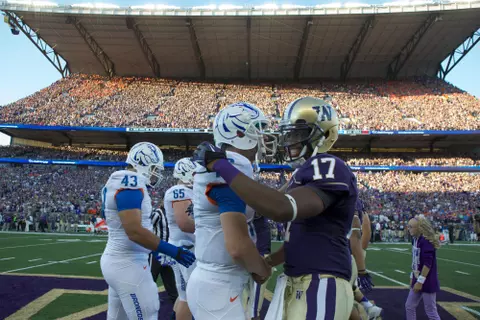
Washington's return to the newly-renovated Husky Stadium was a big occasion in all kinds of ways. Fans were curious to check out the new facility, which underwent much, much more than a simple facelift.
In fact, with the exception of the north upper deck, every bit of the stadium was brand new. The entire lower bowl had been demolished and rebuilt, along with the new east end stands, and new south upper deck, which was broken up into four levels, including a club, suites and two overlapping upper decks.
Below the seating bowl, everything was new too. Where there used to be only dirt, there was now the team's weight room, locker room, training room, meeting rooms and equipment room, as well as a parking garage, a catering kitchen, visiting team locker room and a massive new UW Medicine clinic.
The debut had long been set for the first game of the 2013 season. The project met its deadlines and the new building was ready for its big debut.
The game took on added intrigue due to the opponent. In the final game of the 2012 season, the Huskies had squared off with Boise State in the Las Vegas Bowl, falling to head coach Chris Petersen and the Broncos, 28-26, despite an MVP performance from UW tailback Bishop Sankey, who rushed for 205 yards on 30 carries.

So, the 2013 season opener would be a chance for revenge for the Dawgs, under fifth-year head coach Steve Sarkisian and his senior quarterback Keith Price. Obviously, the opportunity to play the same opponent in back-to-back games is extraordinarily rare.
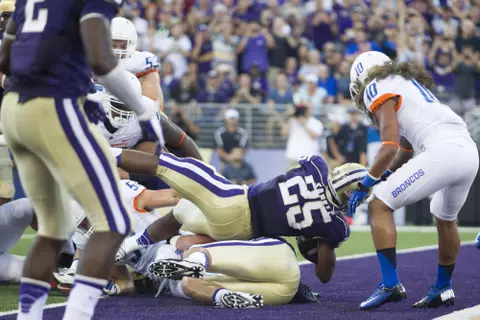
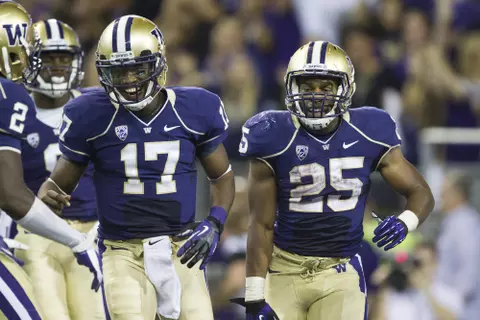
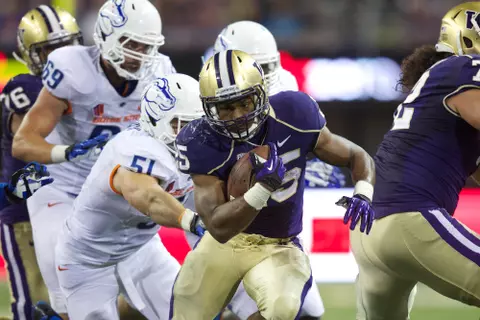
The hype that surrounded the game, and the added incentive for the players eager to avenge a loss, made it a long night for the visiting Broncos. Washington controlled the game from the start, using a hurry-up style that had become vogue in college football around that time.
The Huskies ran 85 plays and rolled up 592 yards of total offense. Price passed for 324 yards and two TDs while Sankey rushed for 161 and two more.
The result was, easily, the biggest loss Boise State ever suffered in Petersen's 104 games (92-12) in charge of the program. In fact, the Broncos endured just four double-digit losses under Petersen, two of them at the hands of the Huskies (2007 and 2013).

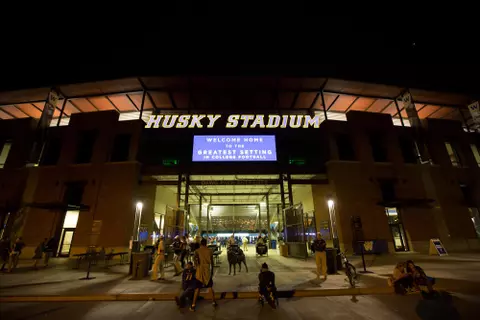
While the game was an obvious success, the star of the night was the stadium, which opened to rave reviews in the following day's newspapers. Seattle Times columnist Jerry Brewer opened his story with the following:
"As you entered spiffy new Husky Stadium — I call it the Taj MaHusky — the video board offered a greeting of grandeur: 'Welcome Home To The Greatest Setting in College Football.'
"It was a simple, graceful nod to a priceless treasure: the area. The University of Washington spent $280 million to rejuvenate a decaying stadium, but money can’t buy the most cherished aspect of enjoying a football game here. The picturesque setting is truly the greatest in the sport with Lake Washington as an accommodating neighbor, with the Cascade Mountains peeking in from the east and the Olympic Mountains from the west. Husky Stadium has been a complement to its perfect location for 93 years now, and from an aesthetic point of view, the renovation that the school unveiled Saturday night was essential to keep up with the surrounding beauty.

"Husky Stadium had to live up to Montlake’s charm. And on this night, in one of the most anticipated season openers in Washington football history, the Huskies were tasked with doing the same.
"For certain, they played to the occasion.
"And this stadium hybrid of old and new shook again, dancing amid eardrum-tickling noise and celebrating a team that made an even louder statement.
"Welcome home: Washington 38, Boise State 6."
In the Tacoma News Tribune, columnist John McGrath noted that the noise levels for which Husky Stadium had always been known – some fans were concerned that the new venue might not be as loud – might have seemed louder, even if more stable. The old Husky Stadium press box had actually hung from the roof of the south upper deck and would rock and sway when the fans got rowdy, a source of fear for many a first-time visitor over the years.
McGrath gave the new stadium a firm thumbs up from an acoustics standpoint:
"The new Husky Stadium rocks louder than the old Husky Stadium. It rocks louder because fans no longer are detached from the field by a track that had the effect of a dry moat. Spectators are on top of things because, well, they're darn near on top of things.
"Aside from enhanced acoustics - everything is louder, beginning with a sound system blaring ads that can be heard on the Snoqualmie Ridge - the achievement of the new Husky Stadium is that convenience hasn't compromised charm.
McGrath's column wrapped up with a nod to the old, swaying press box:
"At 9:21, when Price connected on an 18-yard touchdown pass to tight end Joshua Perkins, the retaking was all but official. The crowd erupted, the stadium pulsated with energy.
"And yet, for the first time in, like, ever, the press box didn't sway.
"Blessed be the architects."
September 30, 2016 -- Washington 44, Stanford 6
It might be that the lopsided final score of Washington's 2016 victory over Stanford tends to diminish Husky fans' memories of just how big an occasion that game was. It's hard to figure how a 44-6 game could be so incredibly enjoyable, if all you see is the score.
But that Friday night game in September of 2016, played on an early fall evening, was the big sporting event of the night: a matchup of a pair of unbeaten, top-10 teams on a national stage.
The Cardinal traveled to Seattle with a 3-0 record, ranked No. 7 in the nation. In the five years since former Stanford wide receiver David Shaw had taken over at his alma mater, the Cardinal had spent nearly every week in the rankings, primarily in the top 10. Shaw had led his team to three Rose Bowls in four years and had an impressive 57-14 career record heading into the UW game.
Washington was 4-0 and ranked No. 10, but the Huskies had struggled a week before at Arizona, needing overtime to beat the Wildcats, 35-28. Expectations for the 2016 were high, but seeing as the Huskies had managed just a 7-6 record and a trip to the Zaxby's Heart of Dallas Bowl a year before, the confidence level was still tempered.

That changed over the course of three hours and 10 minutes on Sept. 30. Washington was dominant in a way that hadn't been seen in Seattle for at least 16 years, if not 25. Stanford was not a team that was accustomed to being dominated in all phases, but that night, the Huskies did just that.
From the start, the sellout crowd was treated to a display of powerful and explosive football from the purple-clad Dawgs.
The first possession of the game saw the Cardinal gain a first down by penalty, but then two sacks and a zero-yard run led to a punt. The Huskies then drove 64 yards on seven plays, with five straight completions from quarterback Jake Browning, to take a lead. The touchdown came on a three-yard pass from Browning to Dante Pettis.


After another stalled Stanford drive, Washington quickly drove 55 yards for another score, this one on a four-yard run from Myles Gaskin.
In the second quarter, Washington added a Cameron Van Winkle field goal and a TD pass from Browning to John Ross to make it a 23-0 score at halftime.
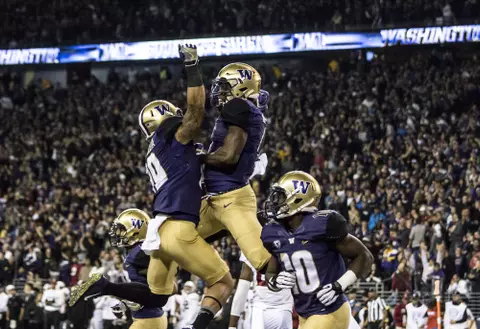
Stanford managed a third-quarter touchdown, but Washington got three more of their own in the second half, on runs from Gaskin and Lavon Coleman and a pass from Browning to Aaron Fuller.
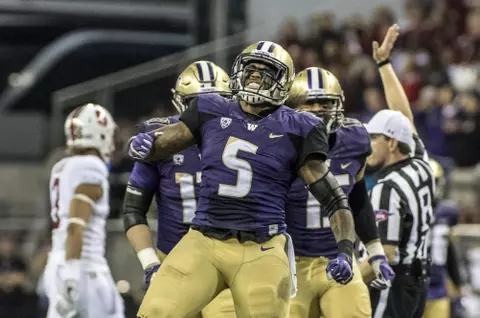
At game's end, Washington had held the Cardinal offense, led by do-everything star running back Christian McCaffrey, to just 29 rushing yards and 184 passing yards. Washington sacked the Cardinal quarterback eight times, with three coming from Psalm Wooching and another two from Joe Mathis, the Huskies' two rushing outside linebackers.
Washington's offense rolled up 214 ground yards and 210 through the air. Gaskin rushed for exactly 100 yards, while Coleman added 74. Browning was an efficient 15-for-21 for 210 yards and three TDs.


In the next day's Tacoma News Tribune, beat writer Christian Caple summed it up well, opening his story with the following:
"They filled Husky Stadium to capacity for the first time this season - for the first time in three years - thirsting for the kind of victory that might indicate, at last, that this Washington Huskies football team is trending toward greatness.
"There were 72,027 of them, UW's largest home crowd since this building's renovation in 2013, and they stood witness to a victory so shockingly dominant that now, it must be said: the Huskies, irrelevant for so long, are the best team in the Pac-12.
"Or, at least they looked like it on Friday night. All night."
A couple of paragraphs later, Caple continued:
"Washington didn't just win. It embarrassed a top-10 team on national television, throttling the overwhelmed Cardinal by a final score of 44-6, burying Stanford quarterback Ryan Burns beneath a relentless pass rush. It was the Huskies' largest margin of victory ever against a top-10 team, and its largest over any ranked team since 1990."

Seattle Times beat writer Adam Jude had a similar take, and noted that the Huskies honored the 25th anniversary of the 1991 national championship during the Stanford game. Jude wrote:
"It took months of planning for the Washington athletic department to pull off a fitting tribute for the Huskies’ 1991 national-championship team at halftime Friday night, complete with fireworks, a standing ovation, long-stemmed roses and many a fond memory.
"It took 30 minutes of first-half domination for the Washington defense to give that ’91 squad the most perfect tribute, its fireworks coming in the form of six first-half sacks and two shutout quarters against a Stanford team that has bullied the Pac-12 Conference for much of the past half decade.
"Final: No. 10 Washington 44, No. 7 Stanford 6.
"Just like old times."
Stanford's suffered a loss that was so unexpected that it seems to throw the entire program for a loop. The following week, unranked Washington State beat them, 42-16, in Palo Alto. Two weeks later, the Cardinal lost to eventual Southern Division champion Colorado. Eventually, Stanford righted the ship and went on to finish the season 10-3 overall, and ranked No. 12 in the final poll.
Washington, of course, took off from there. A week later in Eugene, the Huskies finally broke the Ducks' streak in the old rivalry series, routing the Ducks with a satisfying, 70-21, beating. The Huskies stumbled in a home loss to USC, but finished the regular season 11-1 before winning the Pac-12 title with a victory over then No. 9 Colorado.
The Huskies earned an invitation to the College Football Playoff, giving them their best shot at the national championship since 1991. The Huskies lost to No. 1 Alabama in the Peach Bowl, and finished the season 12-2 overall, and ranked No. 4 in the end-of-season poll.