Montlake Memories: The 1960s
Husky Stadium Centennial Celebration
Jeff Bechthold
10/27/2020
With 2020 marking the 100th anniversary of the first football game at what is now called Alaska Airlines Field at Husky Stadium, GoHuskies.com is marking the milestone with a decade-by-decade look back at some of the big events that have taken place –football games and otherwise – at the Greatest Setting in College Football.
October 29, 1960 – Washington 7, Oregon 6
By late October, 1960, Washington was coming off of a successful 1959 season that ended with a 44-8 Rose Bowl win over Wisconsin, and had opened the 1960 season ranked No. 3 in the nation. The Huskies entered the Oregon game on the last Saturday of October with a record of 5-1, the only blemish a 15-14 loss to Navy in week three.
In the two games before the matchup with the Ducks, Washington had pulled out a 10-8 win over UCLA and a 30-29 victory at Oregon State, beating the Beavers with a late touchdown. Oregon, though unranked, also boasted a 5-1 record.
Prior to the Oregon game, seemingly bad news had struck as eight Husky players, including three starters, had been sent to the hospital with suspected food poisoning. The story was, in the end, worthy of a headline, but didn't seem to play that large of a role in the game's outcome.
The game itself, as the 7-6 score would indicate, was a defensive struggle that went down to the wire.
Oregon's only score came on a five-yard run in the third quarter from fullback Bruce Snyder, who would eventually go on to become head football coach at both California (1987-91) and Arizona State (1992-2000). The Ducks missed the extra point, but a UW penalty gave them another shot. The second attempt was blocked, keeping the Ducks' edge to just six points.
On the first play of the fourth quarter, UW star back George Fleming was stopped on a fourth-and-one attempt at the Ducks' 13-yard line. On the ensuing drive, Oregon reached the UW 24, but also gave up possession on a failed fourth-down attempt. After a UW punt, Bob Hivner (also the UW quarterback) intercepted a pass from Oregon's Dave Grosz, giving the ball back to the home team at the Huskies' own five-yard line.
The Huskies gained first downs on a run and two passes from Hivner, who had taken over at quarterback after Bob Schloredt suffered a shoulder injury in the win over UCLA. Then, on fourth-and-six from the Oregon 47-yard line, Hivner hit Don McKeta with a pass and McKeta did the rest, racing downfield for the score. Fleming booted the extra point to give Washington the lead with just 2:24 left in the game.
Oregon's next drive ended on another Hivner interception of a Grosz pass, at the UW 36. Washington ran out the clock and took home the victory, well on their way to another Pacific Coast Conference title and a trip to the Rose Bowl, where the Huskies would beat No. 1 Minnesota, 17-7.
The win remains legendary in Washington history, mainly for the quick thinking that McKeta displayed. In the next day's Seattle Times, sports editor Georg N. Meyers described it:
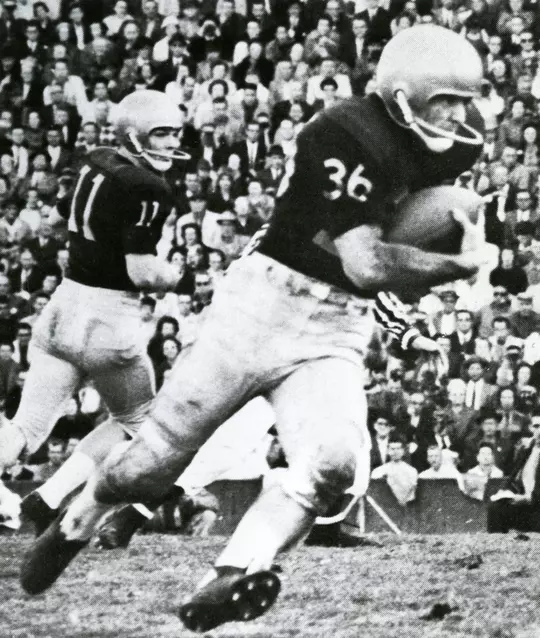
"The Huskies trailed 6-0, with time spilling away when Don McKeta, a thinking man's halfback, snatched a pass from Bob Hivner on the Oregon 37-yard line and slanted toward the sideline. Dave Grayson, the Oregon defender, let logic betray him: With time fleeting, a pass-receiver ALWAYS steps out of bounds to stop the clock.
"McKeta glanced hastily at Grayson," Meyers continued, "and noted a split-second of hesitation. McKeta spun on his heel and, with Dick Arbuckle, safety man, in belated pursuit, sprinted the sideline to a touchdown."
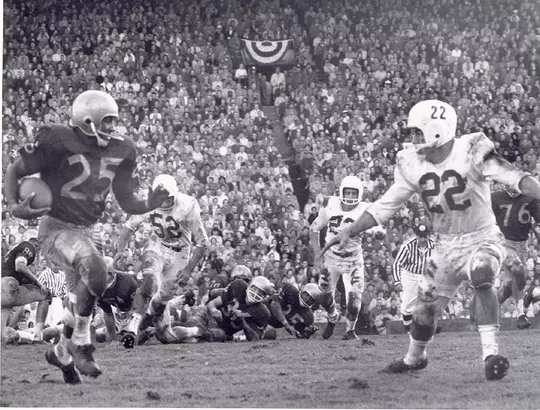
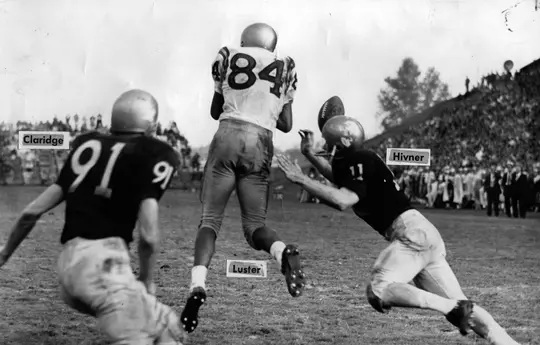
Meyers when on to laud Fleming, as PATs in those days were much less automatic than they are today.
"With 55,7000 frenzied fans in tumult, George Fleming, for the second game in a row against Oregon foes, faced up to the pressure of adding the essential point," Meyers wrote. "But the Ice Man kicketh, stopping the clock and most of the hearts, leaving the longest 2 minutes and 24 second any timepiece ever ticked."
McKeta, about as unlikely a recruit as Washington has ever discovered, came to the UW from a central Pennsylvania coal-mining town. In another column the day after, Meyers wrote the following:
"Oregonians may find it hard to accept that McKeta was almost the original '98-pound weakling.' His high school coach at Robertsdale, Pa., scoffed at him when he turned out for football there. Even now, at 180 pounds, McKeta is a welterweight in the realm of football. But he has the ferocity of a disgruntled rhino and the instincts of a safecracker."
McKeta shunned the spotlight, giving credit to the offensive line. But the headline writers at the Seattle Post-Intelligencer didn't hold back the hype.
Above a series of photos showing the scoring play, one side of the page had the headline, "Don Dodges + Duck Didn't + D-I-S-A-S-T-E-R." The other half of that same spread read "It's Mystic + + + It's Magic + + + It's McKeta!"
The banner on another page in the P-I sports section read: "He Who Hesitates Is Lost -- Duck Defender Did!"
The same day as Washington's thrilling win over the Ducks, one of the worst tragedies of modern, American college football took place, when a plane carrying members of the Cal Poly football team from a game vs. Bowling Green earlier that day crashed. That headline rightly pushed the Husky win down the front page.
The overweight Cal Poly plane crashed during takeoff at an airport in Toledo, taking the lives of 22 of the 48 people on board, including 16 players. Among the survivors was quarterback Ted Tollner, who went on to become head coach at USC in the 1980s. Cal Poly didn't travel to an away game by airplane for the next eight seasons.
Fleming, who was the co-MVP of the 1960 Rose Bowl, played for the Oakland Raiders and the Winnipeg Blue Bombers. He went on to a long career in state politics, spending two years in Washington's state house, followed by 20 as a state senator, retiring in 1990. He currently lives in Seattle's Leschi neighborhood.
McKeta, a two-time all-conference selection, was drafted by the New York Giants in the 20th round of the 1961 NFL Draft, and played for the Saskatchewan Roughriders in the CFL in 1961. He was a member of the UW coaching staff in 1964 and 1965. Now 85, he resides in Sequim, on the Olympic Peninsula.
November 30, 1963 – Washington 16, Washington State 0
The 1963 UW-WSU game, the inaugural year of the actual Apple Cup trophy, was scheduled for Saturday, Nov. 23.
The day before, Friday, Nov. 22, one of the most significant historical events in U.S. history took place, when an assassin's bullet took the life of U.S. President John F. Kennedy, in Dallas, Texas.
While some sporting events went on the following day, all West Coast college football was shut down, postponing all of the traditional rivalry games set to be played that Saturday.
On that fateful day, the morning newspapers previewed the UW game that was to come the following day, with the Seattle Post-Intelligencer's Royal Brougham turning to Longacres horse track owner Joe Gottstein to handicap the game, noting that field conditions might play a part.
By the time the evening papers came out, everything had changed. The late edition of the Seattle Times carried the banner headline "Assassin Kills Kennedy." On that very same front page, just below the fold, was the headline "U.W.-W.S.U. Grid Game Postponed," which stated that UW President Charles Odegaard had already announced that the game would be moved back one week, to Nov. 30.
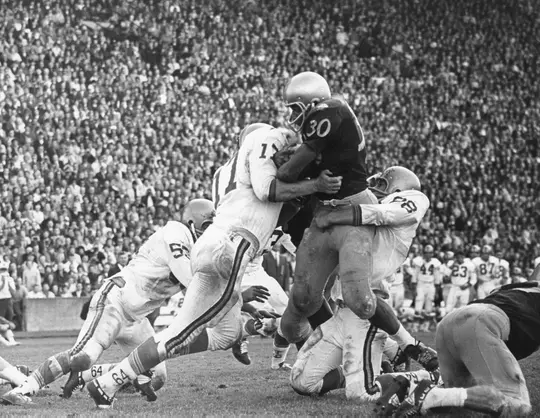
The following day's paper reported that all scheduled games in the west were on hold, most put off for a week. A Times story noted that the Cougars had been working out on the UW practice field in Seattle when word came from Dallas. The team returned to Pullman that night. Three busses carrying the WSU marching band were turned back in Ellensburg by the state patrol.
After a week had passed, the build-up for the game, which was also Homecoming at UW, was back. In Saturday morning's Seattle P-I, a headline stated "' We'll Beat 'Em,' WSU QB Vows," with that very quote from WSU QB Dale Ford.
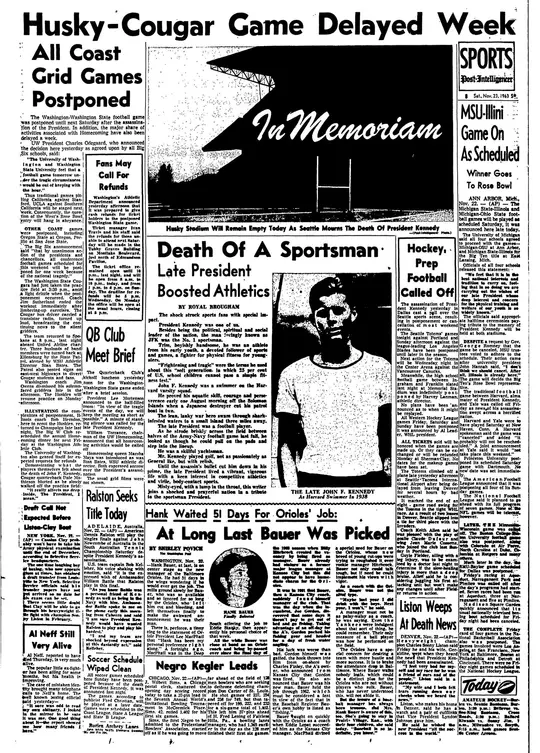
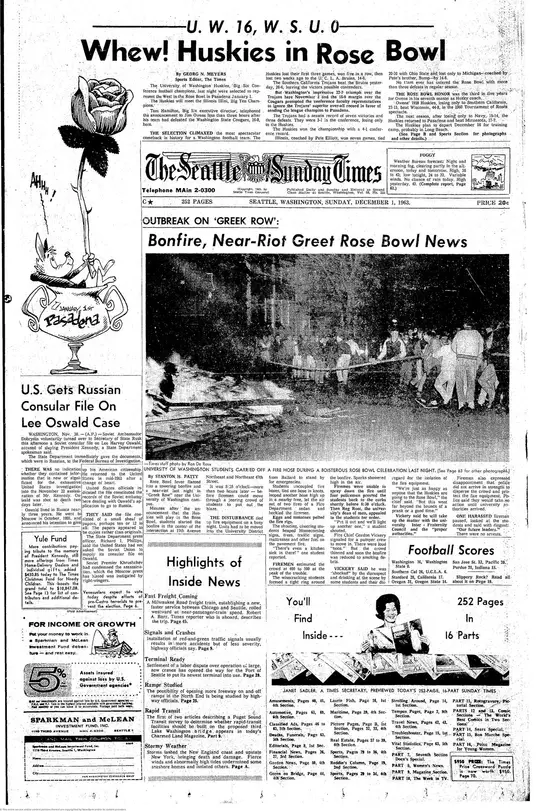
That day, UW fullback Junior Coffey, from Dimmitt, Texas, won the game, scoring both of the Huskies' touchdowns in a 16-0 shutout. Coffey scored early in both the second and fourth quarters, and Washington scored two more points on the final play of the game, when WSU's Dave Mathieson was tackled in the end zone for a safety.
The Huskies, who had opened the season with three straight losses, had done the improbable. A few hours after the game, head coach Jim Owens took a call from conference commissioner Tom Hamilton, who informed him that the Huskies would face Illinois in the Rose Bowl on New Year's Day. It would be the Huskies' third trip to Pasadena in just five seasons.
The celebration of the UW victory on Greek Row grew out of control. The Times' Sunday front page carried a large photo of a bonfire with the headline, "Bonfire, Near-Riot Greet Rose Bowl News." Students who had set the fire, the story detailed, had managed to hold off firefighters for two hours before they could make their way through to extinguish the flames, aided by police.
Illinois beat the Huskies, 17-7, in the Rose Bowl, the Huskies' last trip to the game until Jan. 1, 1978. The '63 season ended up being the last in an excellent run for the program as the Huskies finished in the middle of the pack over the remainder of the decade.
The '63 Apple Cup was not the only career highlight for Coffey, who earned honorable mention All-America in both 1963 and 1964, and was a two-time, first-team all-conference selection.
Drafted by the Green Bay Packers, he was part of their 1965 NFL Champion team. He went on to play for Atlanta and the New York Giants over the course of a seven-year career. Since the mid-1970s, Coffey has worked as a thoroughbred horse trainer at Longacres and Emerald Downs, as well as other West Coast tracks.
November 5, 1966 – Washington 16, UCLA 3
As noted, following the Huskies' 1963 championship season and subsequent Rose Bowl berth, the team's on-field fortunes dipped. The UW finished 6-4 in 1964 and 5-5 a year later, dropping out of the Top 20 early in the '64 season. The Huskies didn't return to the rankings until 1971.
But there were some highlights, including the 1966 Homecoming game vs. UCLA, when the Huskies sent Gary Beban (who went on to win the Heisman Trophy in 1967) and the No. 3-ranked Bruins home with a 16-3 loss.
The two teams traded field goals in the first quarter before the Huskies moved in front, 10-3, on a one-yard run from fullback Jeff Jordan early in the second quarter. Washington put the game away in the third quarter when Frank Smith intercepted a Beban pass and returned it 29 yards for a score.
The charitable description of the game would refer to great defense, but that might be too kind. Beban completed just seven of 24 passes for 87 yards and two interceptions, while UW signal caller Tom Sparlin was just 6-for-25 for 82 yards, with three passes intercepted. Beban did rush for 83 yards, but the UW's top rusher, Bill Parker, ran for just 47. UCLA out-gained the Huskies, 267 yards to 191, but could manage only the one field goal.
The poor weather and muddy conditions were top of mind in the newspaper accounts the following day (P-I headline: "The Huskies Made Bruin Stew In The Goo"), but both coaches – UW's Jim Owens and UCLA's Tommy Prothro – were quick to dismiss that as an excuse.
"Big Bad Bruins Are Only Human; Huskies Win, 16-3" read the headline on the Seattle Times sports section. Sports editor Georg N. Meyers used his column to praise Sparlin, who he noted was playing hurt. Meyers referenced the UW's quarterbacks coach, Bob Schloredt, who had starred for the Huskies a few years earlier. Schloredt had famously lost sight in one eye in a childhood accident.
"A one-armed quarterback, coached by a one-eyed quarterback led a team held together by tape and surgical stitches to the year's biggest upset in college football. Tom Sparlin, his separated left shoulder encased in foam-rubber pillows, followed the instructions of his private tutor, Bob Schloredt, the old Husky All-American, and defied a U.C.L.A. defense which knew Tom dared not run with the football.
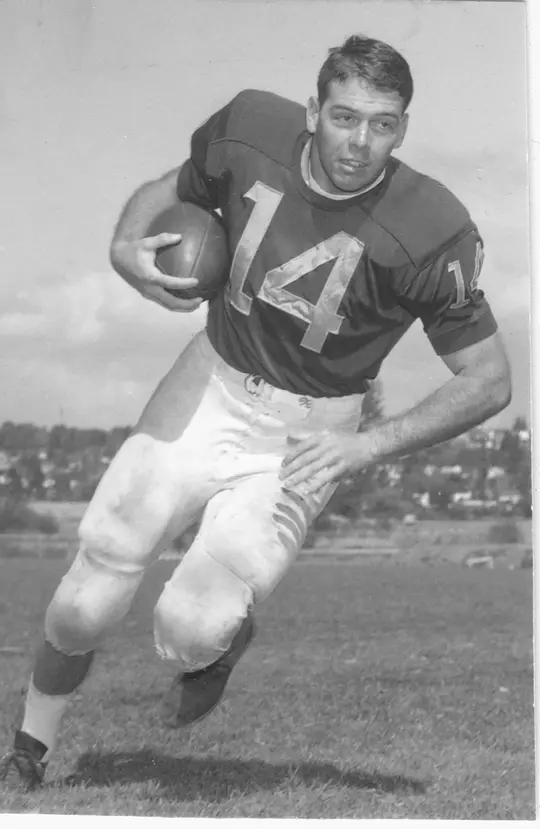
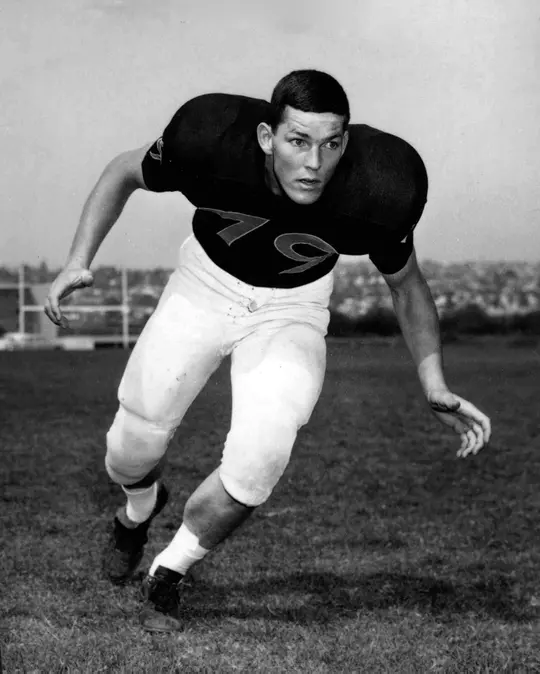
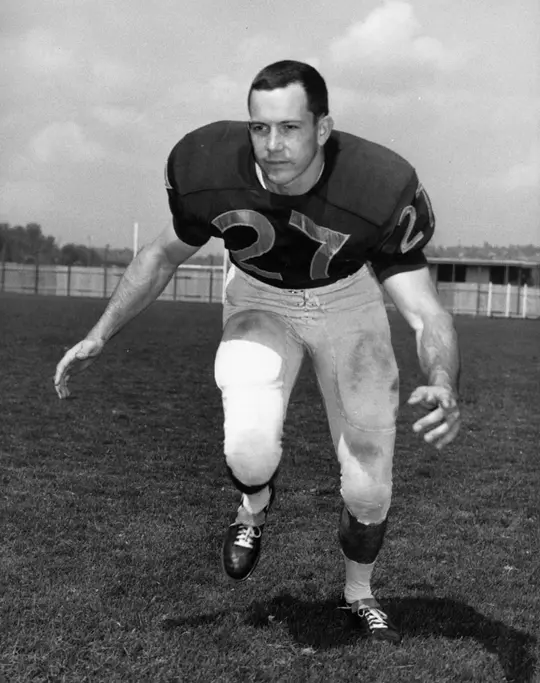
"And Steve Thompson, Jim Sartoris and Frank Smith inspired a fanatical University of Washington defense, which yielded a woefully insufficient 3 points to the highest scoring team in the land. The Huskies' 16-3 triumph will take its place in Washington legend. It was a tour de force compounded of relentless courage, technical perfection, searing motivation."
Another story in the Times referenced a revenge angle. A year before in Los Angeles, the Rose Bowl-bound Bruins had beaten Washington on the controversial "Z streak" play, where UCLA receiver Dick Witcher headed to the sideline as if he was leaving the field, but stopped short and was left uncovered. He scored on a 60-yard pass from Beban.
"I tell you, it was one of the brightest days we've ever had," Owens said after the '66 victory. "We've been waiting a year for this."
November 22, 1969 – Washington 30, Washington State 21
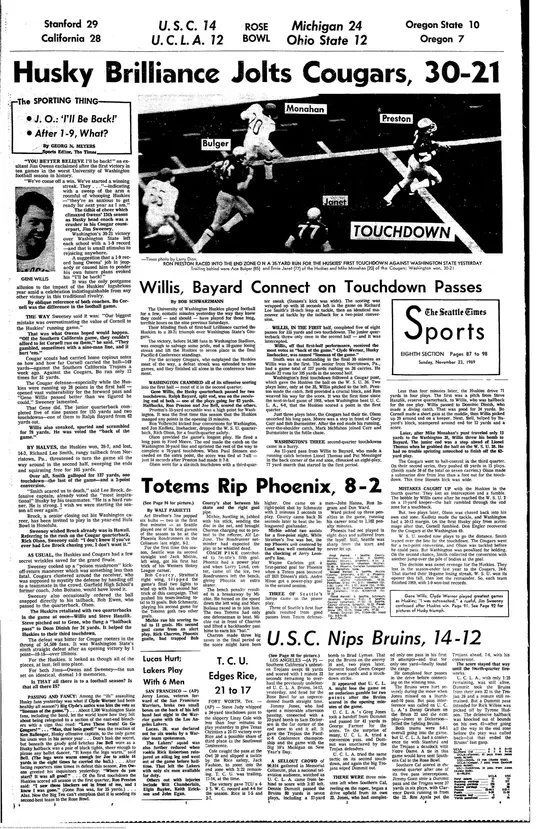
In 1969, Washington entered the final Saturday of the football season still in search of its first victory. The Huskies were 0-9, having struggled through a long slog of mostly lopsided losses to what was a very challenging schedule even for a good team. The Huskies had lost six games to teams ranked in the top 20 during a season that featured a season-opening, non-conference slate of road games at Michigan State and Michigan; followed by a home game vs. No. 1 and defending national champion Ohio State.
That the Huskies managed to beat the Cougars in the Apple Cup and avoid a winless season might seem like a happy end to a miserable year.
But there was much more to it than that. After all, 1969 had been a tumultuous year all over the country as the Vietnam War dominated the headlines. The day of the '69 Apple Cup, the top headline in the Seattle Post-Intelligencer announced the investigation into what would become known as the My Lai Massacre.
Closer to home, the Seattle Times' front page that morning included a story on the tragic death of the 11-year old daughter of Husky Marching Band director William Cole, who along with a friend were killed the day before in a car accident in Stanwood, Wash.
Even closer to home for the football team, the Seattle sports pages had spent much of the fall covering the racial tension that surrounded the Husky program.
In late October, head coach Jim Owens had suspended four Black players – Gregg Alex, Ralph Bayard, Harvy Blanks and Lamar Mills – for their reported unwillingness to formally pledge their loyalty to the team. Later that same week, when the Huskies headed to the airport to travel to a game at UCLA, an additional eight Black players on the travel squad walked off of the team bus. The rest of the team went on ahead to Los Angeles, where the Huskies were beaten, 57-14.
After the UCLA game, pressure on Owens, whose firing was being called for far and wide, forced him to reconsider the suspensions.
The papers covered the story over the coming days and weeks, with meetings scheduled between players, coaches, new athletic director Joe Kearney (who had replaced Owens), UW President Charles Odegaard, other campus administration, members of the Black community, and more.
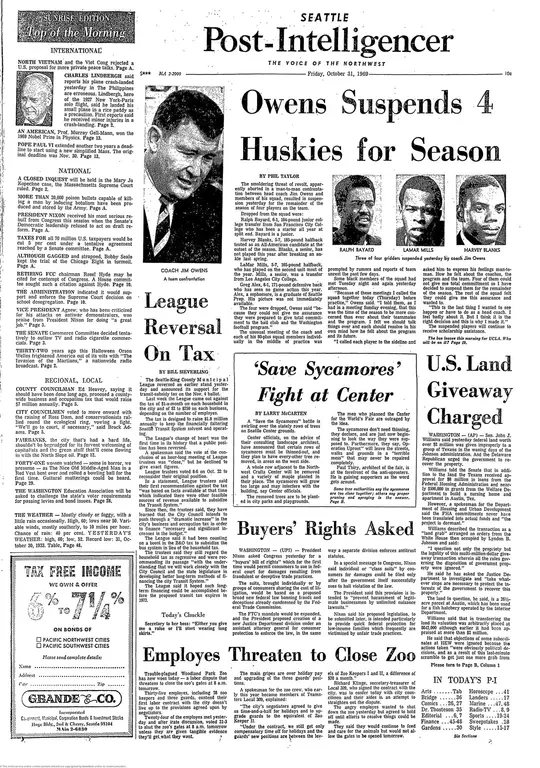
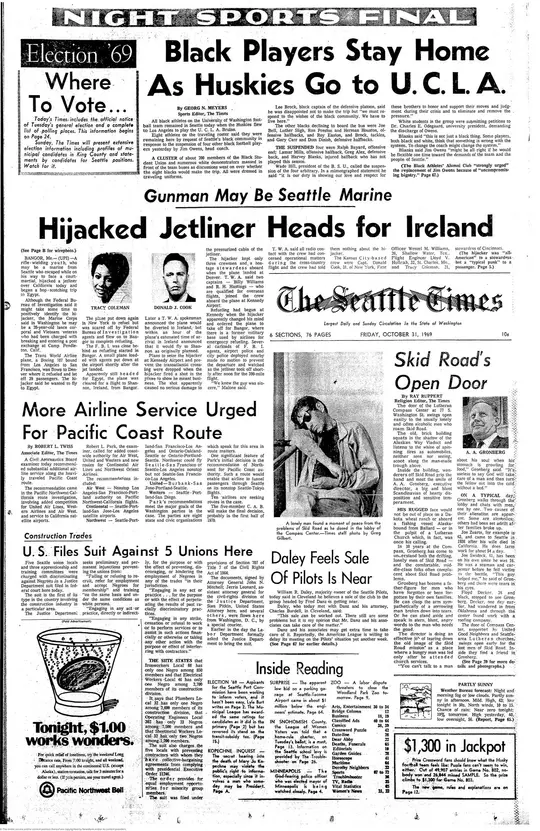
Carver Gayton, a former UW player with three degrees (including a PhD) from the school who had joined the coaching staff in a move to improve the program's racial issues, resigned in protest. Gayton, the first Black coach in program history, came from a family with deep roots in Seattle and had served as a special agent in the FBI prior to becoming a UW coach. He had been hired in part to serve as a confidant and sounding board for the team's Black members after issues had begun to surface in years prior. In his letter of resignation, he cited his feeling that Owens' accounting of the matter that led to the suspensions was inaccurate.
Eventually, the suspension of three of the four players – all but Blanks – was lifted. They'd missed three games (losses to Stanford and USC followed the UCLA game), but returned in time to play in the Apple Cup.
The game itself was a matchup of the two bottom teams in the Pacific-8 Conference: the 0-9 Huskies vs. the 1-8 Cougars. The Seattle Post-Intelligencer that morning included a front-page cartoon graphic with the presidents of the two Universities seated in a half of a lemon, calling the game "The Lemon Bowl." The paper stated, "A hastily-organized UW campus group, named 'Friends Interested in Respectable Entertainment for a Joyous Occasion,' yesterday urged the game have bowl status and suggested that title." The fictional group's named spelled out the acronym "FIRE JO," referring to the UW head coach.
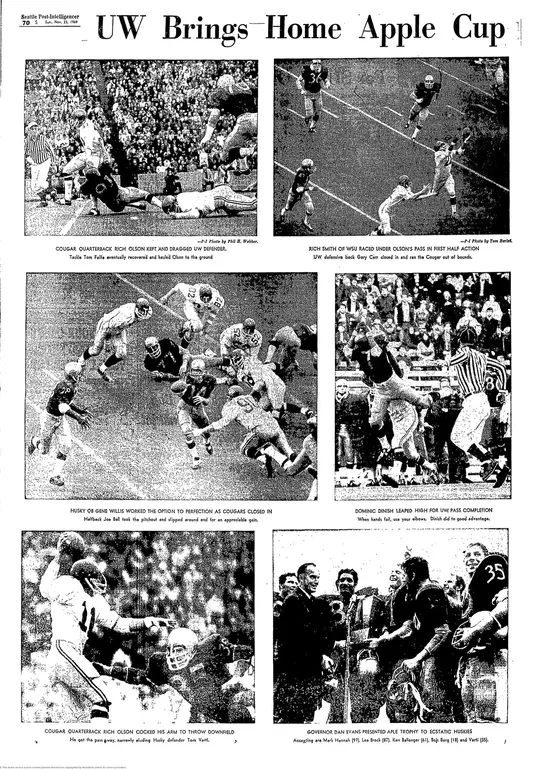
Despite the cold weather, the two teams' poor records, and the recent tumult, 55,677 fans crammed Husky Stadium that afternoon, when the Huskies used a 21-point second quarter to secure a 30-21 victory over WSU, snapping the Cougars' streak of two Apple Cup victories in a row.
Two of the three touchdowns in that second quarter came on passes from quarterback Gene Willis to Bayard, one of the previously suspended four. Bayard scored on passes of 11 and 62 yards – two of only five completed passes thrown that day by the Huskies.
WSU actually held the edge in most statistics other than points scored, out-gaining the UW slightly and winning the turnover battle, four to two.
Cougars head coach Jim Sweeney took the blame for the WSU game plan, which had been to try and stop Husky back Bo Cornell and the UW running game. "The kids did not lose it. I lost it," Sweeney said. "And it really hurts.
"I'm not being a phony in this humility," he continued. "I lost it. I was outcoached."
For his part, Owens declared after the game that he intended to return as the Huskies' coach, which he did, despite all of the turmoil (not to mention the 1-9 record). The following spring and fall, the mania that surrounded new Husky quarterback Sonny Sixkiller and the vastly overhauled Husky offensive style changed the direction and fortunes of the program, at least temporarily.
Owens spent five more seasons at the UW before resigning after back-to-back losing seasons in 1973 and 1974.
Bayard, who earned a PhD from the UW, eventually returned as an assistant athletic director in the 1990s. He has spent much of his time since then working in the child welfare field. Alex, who has run an addiction treatment facility, served 13 years as a team chaplain for the Husky football team and was key in supporting UW players after the devastating injury to Curtis Williams in 2000. Mills became an attorney in Seattle, focusing on public defender work, while Blanks, who had been injured at the time of his suspension and who was never reinstated, earned a master's degree from Cornell and became an actor, director and playwright.